TDG 7: The Other Side of the COIN

Originally posted on American Partisan on April 20, 2021

I started this series, TDG (Tactical Decision Game) Tuesdays, to get you more in the mindset of how you could potentially handle a given tactical scenario with a limited amount of resources and manpower. My goal is to get you to read these scenarios and think about what resources you have available, what sort of scenarios you might encounter, and what gaps you need to fill in your equipment/training.

I will use the basic 5-paragraph operations order format, or SMEAC, to present the scenario as follows;

Situation: Disposition of all friendly, hostile, and adjacent forces.
Mission: What we are trying to do.
Execution: How we are going to do it.
Admin & Logistics: Who/what is getting where and how.
Command & Signal: Who is in charge and how they are communicating.

TDG 7: The Other Side of the COIN

Note: This TDG builds off of TDG 6: COIN. If you haven’t already done that exercise, get your answer to that TDG and then come back.

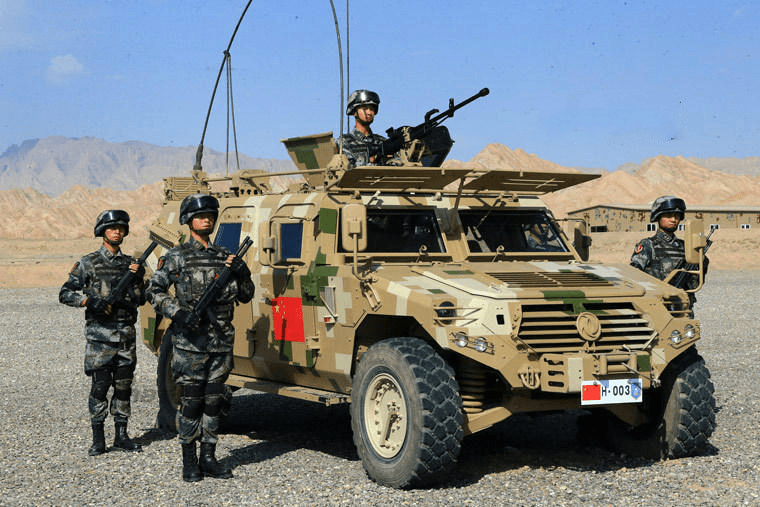
Situation: Guerrilla Warfare Scenario. You are the local guerrilla commander in charge of a small platoon of volunteers fighting the PLA occupation in your county.

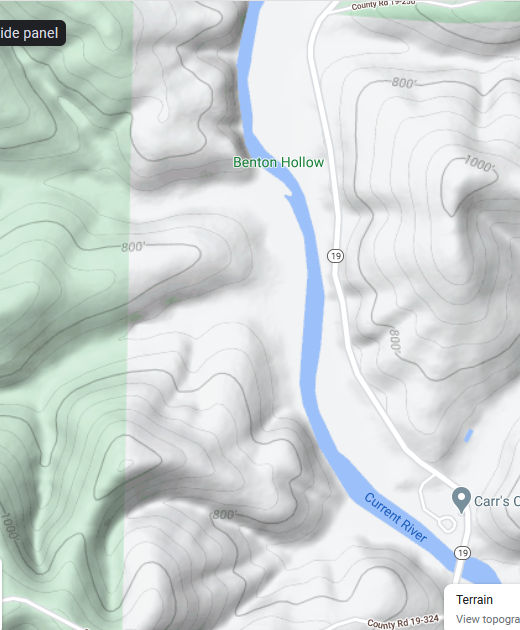
  • OPFOR Situation: The local PLA garrison occupies a FOB just NW of the town of Eminence, as shown on the map. After several successful guerrilla attacks on PLA forces in the last two months, our informant has told us that the local garrison has received some additional units (see TDG 6: COIN).
  • BLUFOR Situation: Following your successful attacks on the PLA, your group has grown in size from the original 17 to a platoon of 30 fighters, broken into three small squads. You are encamped in the forest in the vicinity of Midridge, regularly displacing your base camp when necessary. You are running low on 5.56 ammunition for your AR-15s, but thankfully a successful raid on a PLA checkpoint has yielded some captured weapons and ammunition.
  • Independents Situation: The civilian populace is largely supportive of your guerrillas, and those who aren’t still don’t like the PLA invaders. Local police units have been taken over by the Chinese, but only cooperate as much as they need to. Police checkpoints rarely search vehicles for contraband like they’re supposed to, unless a PLA supervisor is present.
    • ANTIFA, emboldened by the communist occupation and with weapons/training from the Chinese, are essentially a state-sponsored gang at this point. They have a small camp outside the PLA FOB, and they occasionally drive around in large numbers bullying the local populace.

Mission: Based on your analysis of the EMLCOA (Enemy Most Likely Course Of Action) in the last TDG, determine what changes you will make to your operations planning to counter potential enemy actions/changes in SOP.

Execution: Up to you.

Admin & Logistics: Your platoon now has the following resources:

  • 25 AR-15s
  • roughly 500 rounds of 5.56 ammunition
  • 4 captured QBZ-95 rifles
  • 1 captured QBB automatic rifle
  • 700 rounds of 5.8×42 ammunition
  • 1 captured PKM light machine gun with 300 rounds
  • 6 hand grenades
  • 1 underslung grenade launcher mounted on a QBZ, with 10 rounds of HE ammo
  • the same 2 pickup trucks and 5 quads from TDG 5, but with very low fuel.
  • 4x FRS walkie-talkies
  • 10x Baofeng UV-5Rs
  • 2 PVS-14 NVGs, and 2 captured NVGs

Command & Signal: Up to you, be mindful of the enemy’s SIGINT capabilities. Remember, not all communications are electronic.

Once again, the point of this and last week’s TDGs is to drive home the fact that your enemy will adapt their tactics to defeat you, and you must be constantly anticipating those changes so you can be prepared to modify your own tactics. Failure to adapt to your enemy will get your people killed.

Feel free to post your answers in the comments and discuss. Keep an eye out for the recap next Monday!
TDG 6 Recap and Analysis

TDG 6: COIN is different than the ones preceding it in two ways:

  • 1: We are planning at the operational level instead of the tactical
  • 2: We are playing the role of a conventional military commander

Our task is to analyze what our enemy (the guerrillas) have been doing so far and find a way to either thwart their future attacks or destroy them entirely. There were a couple of creative answers to this TDG, with a few trends. Today we’ll do a brief summary of the trends in the answers, and wrap up with the learning objective of this week’s game.

Answer Trends

  • Reliance on SIGINT: Many readers leaned heavily on their signals intelligence assets to locate enemy activity. This is a potent tool and may indeed work. However, this can only get us so far, and a clever guerrilla force will only transmit during operations. We would get some early warning of attacks, and a careless enemy transmitting from their base camp (if they even have one) could net us the whole lot.
  • Motorized Rifle Company QRF: Most solutions proposed the motorized rifle company as a quick reaction force (QRF) to respond to enemy attacks. This is an appropriate use of such a unit. However, this measure is reactive instead of proactive. If there is some way to use our infantry more aggressively to prevent future attacks instead of purely responding to them, that would be better.
  • Brutality towards the populace: Many readers proposed a heavy-handed approach towards the populace, killing or detaining anyone even suspected of being or aiding the rebels. Historically, this approach gets some tactical-level gains but at the cost of strategic-level loss of support from the populace. Eventually we will want to pacify the region, but this becomes impossible if everyone in the county has had friends/family “disappeared” by us.

There were some different methods suggested, one of the more creative ones including using ANTIFA as bait to get the guerrillas to expose themselves. I always commend creativity in unit leaders. The specifics of these answers, however, is beyond what I sought to teach with this TDG, so unfortunately I won’t be able to cover them in depth.

Pattern Recognition

The key to success in any form of conflict from chess to thermonuclear war is twofold:

  • Predict what your opponent will do, and
  • Make your own actions unpredictable

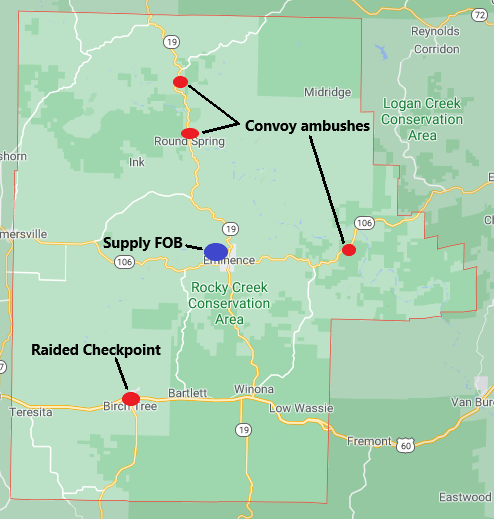
One way to predict what our opponent will do is to analyze their past activity and search for patterns. Patterns can be exploited. Let’s take a look at the map of enemy activity:

Judging from the locations of the convoy ambushes, the enemy seems to be more active North of our FOB. We may choose to concentrate our search to that area with foot patrols, since we do not have enough personnel (1 understrength company) to effectively monitor the entire county. Specifically, we may choose to patrol along our Main Supply Routes (MSRs) where the enemy likes to hit us.

The raided checkpoint in the SW appears to be an anomaly, or it may be the start of a new pattern. We should continue monitoring enemy activity to narrow our search area.

Summary

This is just one example of a pattern we can observe. Patterns are very exploitable and can come in many, many forms. By using pattern recognition to predict the enemy’s future actions, we can adapt to their tactics. Proactive is always better than reactive. We will further explore this concept with tomorrow’s TDG, which builds on the lessons learned from this one.

On our own Shores

Yesterday USNI News published an article entitled “Marines Consulting Outside Experts for Fixes to Recruiting Challenge”. Tucked away in this article is a stunning admission by the Assistant Commandant of the Marine Corps, General Eric Smith. Speaking to a conference of Marine and Naval officers about the recruiting nightmare they face, Gen. Smith said this:

“It is just a matter of time before we are once again called to defend our nation and, perhaps, on our own shores.

Although for most “switched on” individuals this is nothing new, what’s significant about this statement is that it comes from a general officer in the Pentagon.

American military supremacy was an undeniable fact for the last several decades, and we grew comfortable with this reality. Too comfortable. As our foreign policy crumbles before our eyes, along with it goes the security we had here in the homeland. The botched withdrawal from Afghanistan in 2021 was the last crushing blow to our international credibility, and now our allies are losing confidence that we will come to their aid.

Our reputation aside, this skepticism from our allies is not unwarranted. It is no longer simply a question of WILL the United States help our allies, now it is a question of CAN we help them. We are so wholly committed to our proxy war in Ukraine that we have depleted critical national weapons stocks to support it. We have taken tanks and stingers away from the Marine Corps, howitzers and APCs from the Army, and recoilless rifles from the Rangers. And according to the contractors who make these weapons, we cannot replenish our stores for two decades.

Combine that with the recruiting crisis our military faces. I won’t dive too far into why, but the military is no longer able to meet its recruiting goals. There is simply a shortage of people able and willing to sign up for military service and the DOD is struggling to find out why. They simply refuse to acknowledge that their own efforts to shift the culture of the military into a bizarre social experiment are the cause of this crisis, and instead of addressing the real issue they lean harder into their “equal opportunity” efforts.

And now, finally, it has reached a point to where even the deep-seated establishment must acknowledge that we are weaker as a nation than we once were. This admission by a general officer is the first time that anyone in the pentagon has publicly acknowledged the possibility that our foreign policy and military posture are weakened to the point where we may not be secure in the homeland. That they know this is not surprising. That they now openly admit it is concerning, because it means that the threat is so real that they cannot afford to hide it.

In light of this reality, it is more important than ever for every American to be prepared to face a foreign military power at home. It is my opinion that the most likely foreign threat to the homeland comes from our southern border. Thousands of unknown individuals cross into our nation every month, and it only takes a small fraction of them to have military training to constitute a very potent fifth-column threat from inside our borders. Additionally, given the recent attacks on our power infrastructure by home-grown communist revolutionaries, it is apparent that the threat is already here.

The best thing you can do right now is get organized with the people around you. Don’t go online looking for new friends, just talk with your neighbors. You may find that a lot of them have the same concerns that you have. Get organized within your community, get training, and stock up food and ammunition while you still can.

As the General said, it’s only a matter of time before we engage the enemy “on our own shores.”

TDG 6: COIN

Originally posted on American Partisan on April 13, 2021

I started this series, TDG (Tactical Decision Game) Tuesdays, to get you more in the mindset of how you could potentially handle a given tactical scenario with a limited amount of resources and manpower. My goal is to get you to read these scenarios and think about what resources you have available, what sort of scenarios you might encounter, and what gaps you need to fill in your equipment/training.

I will use the basic 5-paragraph operations order format, or SMEAC, to present the scenario as follows;

Situation: Disposition of all friendly, hostile, and adjacent forces.
Mission: What we are trying to do.
Execution: How we are going to do it.
Admin & Logistics: Who/what is getting where and how.
Command & Signal: Who is in charge and how they are communicating.

TDG 6: COIN

Situation: Guerrilla Warfare Scenario. You are a PLA (Chinese) Lieutenant Colonel in charge of a rear area where your troops have been subject to ambushes by a local guerrilla force. You command a logistics battalion, but division has granted you additional units to help secure the region.

  • OPFOR Situation: Enemy guerrillas are operating in your AOR and have proven to be quite a thorn in your side over the last few weeks. They recently ambushed a supply convoy that was your responsibility to protect, destroying vital ammunition and fuel headed to the front lines in the North. Their strength is unknown, but estimated to be between 15-30. Previous attempts to pursue them have been fruitless, as they seem to vanish into the countryside once your troops try to counterattack.
  • BLUFOR (PLA) Situation: Your AOR is Shannon County, Missouri. Your Logistics FOB is located near the town of Eminence at the location marked on the map. You command the PLA 27th Logistics Battalion* with about 1,000 organic personnel, including FOB and convoy security detachments. In light of recent guerrilla attacks, division HQ has granted you what units could be spared to assist you in securing your AOR.
  • Independents Situation: You have limited proxy support in your area. Indigenous Law Enforcement agencies seem to be cooperating thus far, but you suspect that certain of them may be feeding intel to the guerrillas. You also have the support of the local ANTIFA chapter, comprised of about 50 volunteers, which our embedded trainers are doing a good job of arming, training, and indoctrinating to function as semi-autonomous pro-China militias.

Mission: To destroy or force to disband the local guerrilla band in order to stop the attacks on PLA convoys and security forces.

Execution: Up to you. Determine how you will use your available forces to accomplish the mission.

Admin & Logistics: In addition to your organic supply personnel, the following units have been assigned to your command:

  • light motorized rifle company at 70% strength, sent back from the front (30% casualties are generally considered enough to render a unit “destroyed” or at least “combat ineffective”)
  • A SIGINT detachment with radio direction-finding and jamming vehicles
  • 2 additional ISR drones, capable of 50 hours continuous flight time in ideal weather, with visual and thermal cameras
  • A 15-man team from the “Night Tigers” special forces group, specializing in counter-terrorism operations.

Command & Signal: You retain operational command and control of all of your detachments except the “Night Tigers” SOF team, which operates autonomously. You can communicate with your units via a combination of SATCOM, HF, and VHF line of sight radios, detailed comm plans will be drawn up by your communications officer as needed.

As you can probably tell, this week’s TDG is a sequel to TDG 5: Convoy Ambush. Any time you take action against an enemy, especially successful action, expect them to react to your operations by making some sort of change. You should try to anticipate these changes by putting yourself in the enemy commander’s shoes, like I’m having you do in this scenario. You can then be prepared to adapt to the enemy’s changes quickly. This is a never-ending cycle in counterinsurgency operations (abbreviated COIN), and really all forms of war. The most flexible commander almost always prevails.

Feel free to post your answers and discuss. Stay tuned for the recap next Monday!

*Fictitious unit based off OSINT about PLA and USA logistics structure.

TDG 5 Recap and Analysis

TDG 5: Convoy Ambush” finds us deep in an enemy rear area near their support units. This is perfect for a Guerrilla force, which can bleed the enemy by attacking his vulnerable supply routes. Our intelligence (which we had to gain ourselves through a recon patrol) tells us when and where an enemy supply convoy will pass, and we must decide how to ambush them. I will approach this TDG with a list of the “phases” of this operation, listing our options as we go.

Stopping the Convoy

Simply sitting on the hillside pouring rifle fire into the convoy will not work, as they will be quickly through our kill zone before we can do any real damage. Since we do not have any heavy weapons (like an AMR), we have to get creative with whatever we have on hand.

Reader “John” suggested sending an unarmed element to drop trees across the road, a simple task with the chainsaws that every farmer has in their shed. He went a step further to drop trees behind the convoy as well, to slow down reinforcements and cut off escape. “…if we get caught, our cover for action is we are cutting firewood…. Totally innocent since we are unarmed.” Cover for action is always good to consider for a guerrilla.

“Teddy Bear” wanted to commandeer school buses (or other large vehicles) to block the road. This could work, as even a Tigr wouldn’t be able to simply push a school bus out of the way.

“Vikingwanderer” suggested using nails and other sharp objects to pop the tires. However, as “John” pointed out, “Most, if not all, [military] wheeled vehicles are equipped with run flat tire inserts. Popping the tires isn’t going to do much to degrade capabilities.”

A couple other readers suggested, without getting too specific, the use of improvised explosives or explosive projectiles. Assuming that we have the resources and skills to pull this off, it could possibly work. Although most readers focused on taking out the armored vehicles, I would add that an incendiary device (especially a launchable one) could potentially burn a supply truck if we time it right. If we can pull this off, we may even be able to accomplish our mission (destroy supplies and vehicles) without getting into a messy gunfight.

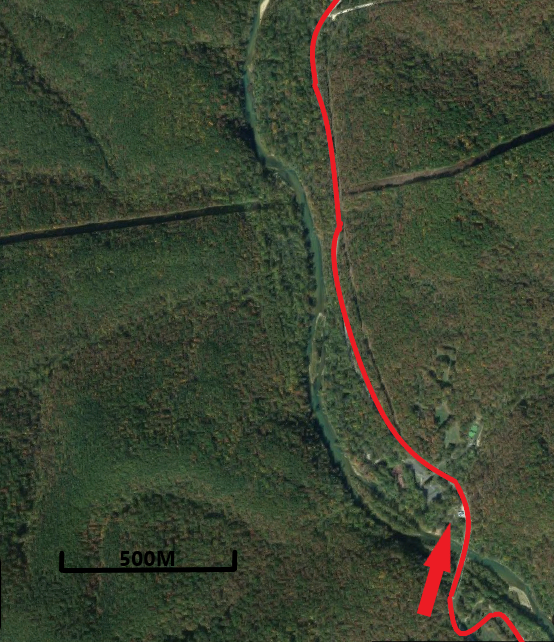
The last consideration here that was largely ignored is the question of where do we conduct the ambush? “Teddy Bear” wanted to do it at the bridge to the South, rather than on the straightaway that dominates the center of the map. This location has a couple of advantages, among them the fact that the bridge follows an S-curve in the road. Stopping the enemy on that curve would mean that some of the escort vehicles would be out of sight of our ambushers, reducing the threat to ourselves when we open fire. It also means that they would have less time to see and react to any blockage we lay down on the road. This leads to the next phase: the ambush itself.

The Ambush

The next consideration is how to initiate the ambush. We should time our method of stopping the convoy so that they don’t realize that they are being ambushed until it is too late. This means that it’s a bad idea to let the enemy see trees/buses/whatever blocking the road before we open up on them, as that lets them take evasive action and costs us a bit of the surprise that we need to prevail.

We can either hide our roadblocks or wait to emplace them at the last second. The only way to “hide” trees or buses across the road is to place them at a bend or after the crest of a hill, so the enemy comes upon them too suddenly to react. This is another advantage to ambushing at the S-bend right before the bridge.

If we ambush on the straightaway, we need to wait until the last second to block the road and spring the trap. Driving buses across the road is easy enough, but the drivers will probably be engaged immediately by the lead escort vehicle. Dropping the trees across the road last second is doable with the chainsaws. Or, as “Mighty Tortuga” proposed, we can “use tannerite to blow the trees over.” The options are only limited by the imagination.

The biggest danger to ourselves in this ambush is time. Once we kick off the ambush, the clock is ticking before the enemy QRF and ISR assets arrive. As “John” said, “Suprise, violence of action, and speed are key here.” We need to quickly cause as much damage as possible and then leave. An easy way to control this with a half-trained team is by limiting ammo expenditures. “Everyone on the ambush engages for a mag or two (mad minute) and then withdraws to the ORP.”

Withdrawal

Once we’ve decided to break contact, we should get as far away as possible from the ambush site before the enemy drone arrives looking for us with its thermal cameras. If the drone arrives before we’ve cleared out, it could follow us back to our base camp or homes, and then we are in real trouble.

Withdrawal routes/methods were not discussed in the replies to this TDG, but they are important nonetheless. Whatever our route/method, it should either be well-concealed or very quick. There is a lot of tree cover, so there are many concealed routes out of the area. If we use vehicles, we should egress to the North along the road. The enemy cannot be allowed to see our trucks, or they will put a BOLO out on our vehicles and track us down later.

Another option is using the four-wheelers. The horizontal line in the NE part of the map is a power line cutaway, which could be an excellent high-speed escape route for the four wheelers. Just another option, the downsides are of course that we are easier to spot if the drone happens to arrive earlier than expected, or if we are forced to engage the enemy longer than planned.

Summary

Heavy weapons are nice to have, but we can’t always count on having them. The solution is to get creative and improvise low-tech options to overcome these shortfalls. This TDG was designed to get you thinking outside the box, which a couple of you did. There are infinitely many ways to solve this TDG, and I encourage you to share it with your friends. Their creativity will surprise you, and open your eyes to a world of options you never knew existed.

Thank you to everyone who participated in this TDG. In the future, I will hold off on the recap for a few more days to give more people a chance to play. The more participation a TDG gets, the more everybody learns from them. The more we learn, the more dangerous we become.

Semper Discens. Stay dangerous.

TDG 5: Convoy Ambush

Originally posted on American Partisan on April 6, 2021

I started this series, TDG (Tactical Decision Game) Tuesdays, to get you more in the mindset of how you could potentially handle a given tactical scenario with a limited amount of resources and manpower. My goal is to get you to read these scenarios and think about what resources you have available, what sort of scenarios you might encounter, and what gaps you need to fill in your equipment/training.

I will use the basic 5-paragraph operations order format, or SMEAC, to present the scenario as follows;

Situation: Disposition of all friendly, hostile, and adjacent forces.
Mission: What we are trying to do.
Execution: How we are going to do it.
Admin & Logistics: Who/what is getting where and how.
Command & Signal: Who is in charge and how they are communicating.

TDG 5: Convoy Ambush

Situation: Guerrilla Warfare Scenario. You lead a small band of guerrillas fighting against the PLA.

  • OPFOR Situation: Your AO is a PLA “rear area” with only minimal forces for security, as the bulk of their units are about a hundred miles Northeast at the front. Reconnaissance has determined that the PLA routinely sends supply convoys through your area carrying fuel, munitions, rations, and medical equipment in unarmored trucks. Normal composition of enemy convoys are 6-10 supply trucks with armored security vehicles at the front, middle, and rear of the convoy. The troops you will be fighting likely do not have combat experience. However, their ROEs are not very restrictive, and are more designed to prevent friendly fire than collateral damage.
    • Reinforcements: there is a QRF located at the logistics depot approximately 10 miles south of the location pictured on the map. They use the same armored vehicles as the convoy escorts. They do not have rotary wing support this far in the rear, but they do have an ISR drone available to launch upon the QRF getting triggered. They do not have constant drone coverage available for force protection.
    • Supporting units: There is a supply battalion at the depot 10 miles to the south where the convoys originate, co-located with an engineering company.
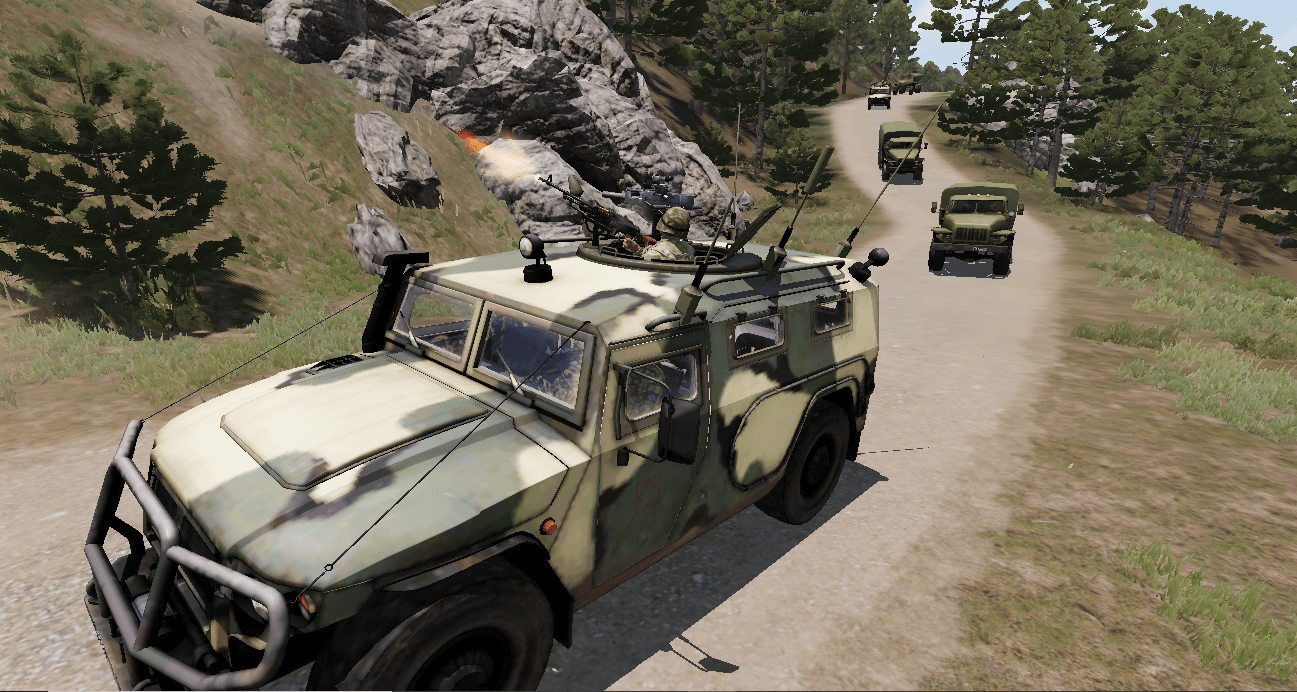
A GAZ Tigr, an armored car commonly used by the PLA and Russian militaries, and the most likely escort vehicle for this exercise.
  • BLUFOR Situation: You lead a squad plus of 17 guerrillas, consisting of four 4-man fire teams and yourself. You all live in the area and have trained/operated together previously, but you do not have any heavy weaponry. One of your fire teams has just returned from spending a week in an observation post overlooking the road, so you have the convoy schedule and you know that the next one will drive through in three hours.
  • Independents Situation: There are no houses in the map, and civilians are unlikely to be in your operating area. The populace is not in favor of the occupation and is sympathetic to the guerrillas, so it is unlikely that they will report your group if they see you. There are no adjacent friendly militias that you are aware of.

Mission: Ambush the next convoy and destroy as much of the supplies and vehicles as possible in order to bleed the enemy and pull some pressure off of the front.

Execution:  The current time is 0300, your people are assembled and ready to go.  The convoy will be at the bridge in the bottom of the map at 0600 local time, traveling the highlighted route in the direction indicated by the arrow at about 50mph.  Sunrise is at 0630.  Everything else is up to you.

Admin & Logistics: You have the following resources available:

  • every man’s personal AR-15 with 600 rounds/man.
  • 5x 2-seat Four-wheelers
  • 2x pickup trucks
  • 4x FRS walkie-talkies
  • whatever you happen to have in your house/barn/workshop in the way of tools, building supplies, chemicals, etc.

Note: Just because I list something here doesn’t mean you need to use it.

Command & Signal: You are the Squad Leader. You can delegate to your four Team Leaders if you so choose. Your comm plan is up to you, remember to use a PACE plan.

I want you guys to get creative here. Don’t get hung up on how little you have to work with, think outside the box and find a way to accomplish your mission.

Feel free to post your answers in the comments and discuss (or don’t, if it compromises OPSEC). Stay tuned for the Recap on Thursday!

If you like these TDGs, sign up for a Team Leader II class sometime to practice these skills in person with a real team of fellow students.

NEW CLASS: Team Leader II

If you’ve followed me for any period of time, you’re familiar with the Tactical Decision Games (TDGs) that I put out on Tuesdays. My goal with those games is to get you to practice making tactical decisions and work through some basic mission planning. I now offer the chance to learn and experience the troop leading process with my new class, Team Leader II.

I cut my teeth in the training industry with my “Team Leader Class”, now called “Team Leader I“. My goal in that class is to teach students how to mold a group of like-minded individuals into a cohesive team. I teach small unit task-organization, creating a customized training plan for your team, conducting training events, and some tactical fundamentals. You leave Team Leader I armed with the knowledge and confidence to get your friend group organized and trained. That class has been very successful, as shown by my student’s reviews.

Team Leader I makes you an organizer and a trainer. Team Leader II develops your skill as a combat leader. Through this 3-day course you will get instruction and practice in mission planning and small unit tactics, with an emphasis on developing your tactical decision making. This class involves a good amount of force-on-force, meaning you get to pit yourself against a living, thinking opponent.

Topics covered include:

  • Mission selection
  • Mission Planning
  • Patrol route selection
  • Operations order creation
  • Leading rehearsals
  • Tactical decision making
  • Combat leadership

Unlike other small unit tactics courses, Team Leader II ensures that you get to practice leading a team yourself. This is critical for you to know and practice the why behind the what of the tactics, so you know how to use your “tactical toolbox” of skills. The use of force-on-force allows even experienced students to hone their skills against a dynamic adversary.

Team Leader I is not a prerequisite to attend this course, but I do recommend that you take these classes in order.

The packing list for this class can be found here. The next class is up on the training schedule for February 10-12, contact me directly to reserve your spot.

TDG 4 Recap and Analysis

This week’s TDG finds us in a civilian QRF action, a modern equivalent of the Minutemen of the 18th century. Our friend Kevin is under attack in his home, and it falls upon us to save him. Nobody else is coming, it is up to us.

Fortunately, our group has planned for this possibility and trained to respond to each others’ houses. We are at a pre-established Objective Rally Point (ORP), ready to take action. We have many options and a couple tools at our disposal. Let’s take a look at some of them.

The Drone

We have a small quadcopter drone, and some readers wanted to use it to do reconnaissance of the objective, confirming the actual location of hostile forces. There was a healthy bit of debate on this topic, as some readers argued that the drone could do more harm than good. Reader “thefinalappeal” said, “Forget the drone. unless it has thermal capability, it is going to be useless at night. As someone else said its noise alone could give away the op.

This raises a fair point. It is currently 2am, so it is quite dark. However, if the area is illuminated by street lights, we may still be able to see some of what is going on. However, this limited gain in situational awareness must be weighed against the time it takes to get the drone airborne, not to mention the risk of losing our surprise if it is seen or heard.

There are also other ways to use a drone, besides pre-mission reconnaissance. One needs only to look at the conflict in Ukraine for a vast number of ways to use this revolutionary battlefield asset. I cover this in detail during the Jäger Course.

The AMR

Our 2-man AMR team is able to detach and function independently. Several readers chose to do so, sending them to engage the MRAP while the fire team assaults the East side of the house. This is good weapon-to-target match, as the AMR is perfect for engaging light armored vehicles with the right ammunition.

However, the question arises; do we need to engage the MRAP? Reader “Ghostman” had this to say:

“…ignore the MRAP, kill the cartel members at the rear and have your friends run out the door and into the woods to the escape vehicle. The MRAP is an obnixous pos in that situation that can’t chase you into the treeline.”

Our adversary has strength in their numbers and the armored vehicle in the street. If we can avoid engaging the enemy’s strength, we can accomplish our mission with minimal risk by only striking where our opponent is weak. It is very easy to get tunnel vision on the biggest threat, armored vehicles are as much psychological weapons as they are physical weapons. Play it smart and you can avoid the biggest threat altogether. Our mission is not annihilation of the enemy, it’s the extraction of Kevin and his wife.

On the other hand, a 2-pronged attack would help slow the enemy’s reaction time. This leads to the next topic.

Speed as a Weapon

All the answers submitted by readers acknowledged that we do not want to stick around for long. The enemy outnumbers and outguns us, so our best chance of success is to act quickly and leave with Kevin before the enemy has time to realize what’s happening and bring his numbers to bear on us.

“Ghostman” said, “…move with speed and employ violence suddenly and effectively.” Reader “Bryan” also pointed out, “Entire process should be executed with speed and surprise as a priority, as ammunition is at a premium.” We can’t afford a long, drawn-out gunfight due to our limited ammunition. This is yet another reason to move in with violence, create confusion, and disappear into the night.

The longer we stick around, the more time the enemy has to maneuver his forces to flank us or (worst case) cut off our exfil route. We can, perhaps, buy ourselves a couple more seconds of time by attacking the enemy from two different directions with the AMR team. Fire from two directions would hopefully slow down the decision-making process of the enemy commander, helping our assault team to do their job and get away. Smoke grenades would be a good asset for breaking contact in this situation.

Summary

There are two main points I want to leave you with. First, just because you have a tool doesn’t mean that you need to use it every time. Choose the best tactics and then decide which tools enable them.

Second, speed is a weapon. You are up against breathing, thinking humans. If you can make decisions faster than your opponent, you maintain the initiative and the advantage. A quick, precise application of violence can enable a small force to get the best of a larger one. Apply the right amount of swift violence to accomplish your mission and get out.

Third, this scenario is not possible without prior planning and coordination. If the group of men in this TDG had not planned to respond to each others’ houses, if they had no way to alert each other, then they would have simply woken up the next morning to find that Kevin and his wife were dead. If you have a mutual assistance group, make sure you train together and train realistically for whatever missions you see yourself conducting in the future. Failing to plan is planning to fail.

If you want to learn how to organize and train your people, come to a team leader class. I will teach you how to organize, train, and lead your group of friends so you can mold them into an effective team.

TDG 4: Alamo! Alamo! Alamo!

Originally posted on American Partisan on March 30, 2021

I started this series, TDG (Tactical Decision Game) Tuesdays, to get you more in the mindset of how you could potentially handle a given tactical scenario with a limited amount of resources and manpower. My goal is to get you to read these scenarios and think about what resources you have available, what sort of scenarios you might encounter, and what gaps you need to fill in your equipment/training.

I will use the basic 5-paragraph operations order format, or SMEAC, to present the scenario as follows;

Situation: Disposition of all friendly, hostile, and adjacent forces.
Mission: What we are trying to do.
Execution: How we are going to do it.
Admin & Logistics: Who/what is getting where and how.
Command & Signal: Who is in charge and how they are communicating.

TDG 4: Alamo! Alamo! Alamo!

Situation: “ALAMO! ALAMO! ALAMO! NOT A DRILL!” reads the 2am encrypted chat message from Kevin, your friend and teammate. Alamo, the code word for one of you coming under siege in your own home, has never been used outside of training before. Thankfully, you knew this day would eventually come and you all trained accordingly. You pass on the message to the other members of your team, grab your minuteman kit off its ready rack, and head off to the predetermined ORP for Kevin’s house.

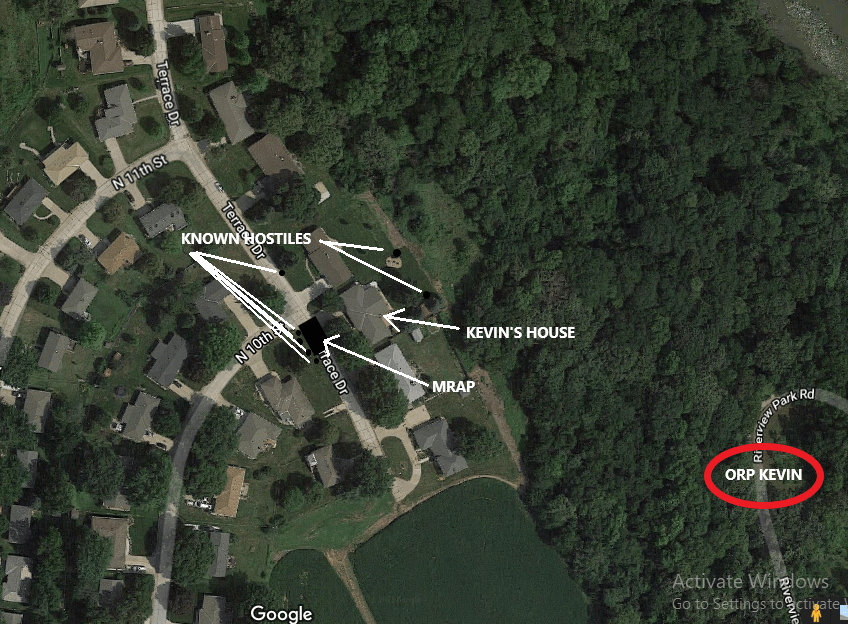
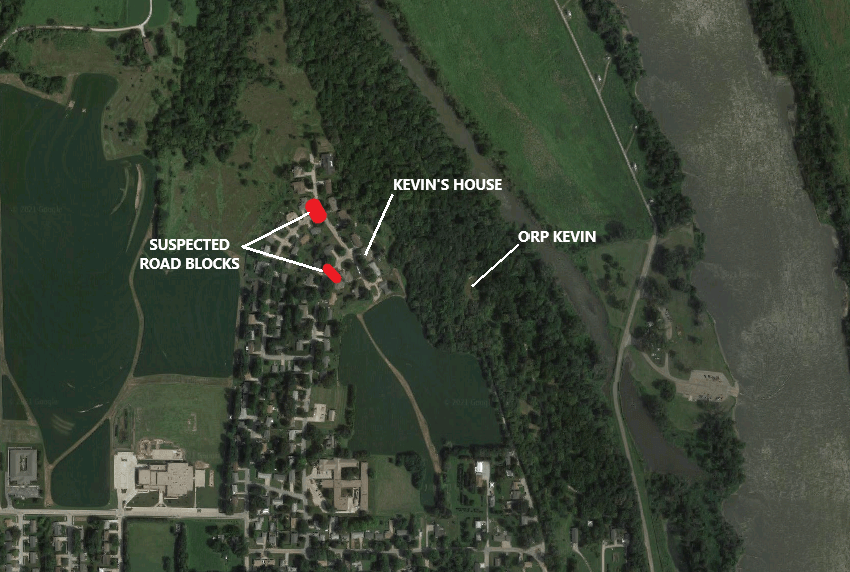
  • OPFOR Situation: A well-armed, trained, and organized cartel has surrounded Kevin’s home and attempted a no-knock raid, which failed and has now turned into a standoff. They have an armored MRAP and about 20 men on scene, most of whom are common enforcers armed only with handguns, but with a highly trained 10-man assault team armed with assault rifles and body armor. Known enemy positions are indicated on the map, but only represent what Kevin knows about and can tell you over the radio. In addition, you can expect them to have roadblocks set up on avenues of approach. Hostiles can be easily PID’d via their uniforms and body armor, and distinct markings on vehicles.
  • BLUFOR Situation: Kevin and his wife, alerted by their dogs, managed to ambush and repel the initial attempt to storm their home and are now barricaded inside. Kevin has concealed CCTV cameras around his house running off a reserve battery that the cartel don’t know about, which is how he is able to spot and report enemy positions to you. You, the team leader, meet up with the remaining 4 members of your fire team plus at ORP Kevin, shown on the map above.
  • Independents Situation: There are multiple civilians in the houses surrounding Kevin’s, and the cartel has made no attempt to evacuate them. There is no external support or adjacent friendlies, it’s up to you.

Mission: Extract Kevin and his wife in order to get them out of harm’s way.

Execution: (Up to you. Remember what the mission is and don’t get sidetracked.)

Admin & Logistics: You have the following resources:

  • 5 shooters, including yourself, the 2 remaining members of your fire team, and a 2-man AMR team
  • 4 AKMs with 180 rounds each (6 mags)
  • 1 .50 cal AMR with 30 rounds of API
  • 1 small quad-copter drone with remote camera
  • 4 handheld VHF/UHF radios

Command & Signal: You are the team leader. Your AMR team has trained to work semi-independently in the past and can be detached from the rest of the group if you choose. Your comm plan was set ahead of time, and is as follows:

P: Alamo1: 450.25MHz, for talking to Kevin

    Valkyrie1: 447.70MHz, for talking within the team

A: Alamo2: 138.33MHz

    Valkyrie2: 133.85MHz

C: Signal whistle

E: Orange reflective panels inside everyone’s hats

While you consider your plan, think about how much harder this would be to organize and how much slower your response time would be if you hadn’t prepared like the team in this TDG.   Then consider how this could potentially work out for you and your friends/teammates.  Do you know how you would respond to a call for help from your best friends?  Do they know how to respond to you should you need it?  Have you practiced responding to each others’ homes?  Failing to plan is planning to fail.

And if you don’t know how to train your teammates to work together, I have a class for that.

Feel free to post your answers in the comments and discuss. Stay tuned for the recap in a few days!

TDG 3 Recap and Analysis

In this week’s TDG, we are greatly outnumbered and outgunned. A company of troops has set up just a few miles from our camp and is most likely looking for us. Fortunately, we still have time to take action. The mission I gave was for you to conduct a security patrol to locate and attack enemy LP/OPs. However, as many of you pointed out, that wasn’t the only course of action available to us.

Conduct the Security Patrol(s)

Since we anticipate that the enemy is looking for us, we could conduct the patrols as planned to hunt for their LP/OPs. This would hamper their efforts to find us. However, this Course of Action (COA) is a bit risky.

The enemy, in static LP/OPs, will be much harder to detect than our security patrol. That means that our patrol will most likely be spotted. If the infantry was our only concern, we could argue that this is an acceptable level of risk. However, this is a conventional military unit with organic indirect fire (IDF) weapons such as mortars, which we are well within range of.

Once detected, our security patrol would most likely be targeted by mortar fire, with the LP/OP spotting and adjusting the impacts. Our patrol would be attacked and likely take casualties without ever seeing the enemy.

Build a Decoy Camp

One commenter suggested the idea of building a fake camp away from our location to draw the enemy’s attention. If possible, he recommended ambushing the enemy when they moved to attack the decoy camp.

When I worked in a Regimental COC, our command actually tried this once during a training exercise. They had us build a fake command node, partially camouflaged and with a few radios, to draw the eye of the OPFOR’s aerial surveillance. It was a massive failure and didn’t fool anybody. When the enemy went to observe it, they quickly realized that it was fake because there was almost nobody there, and nowhere near the level of activity our actual COC had. There were other factors too, but they’re beside the point.

When you plan to raid a target, you get eyes on it and watch it for hours or days to collect as much info as possible before you risk lives assaulting it. The enemy would quickly realize that the decoy was bogus due to the lack of activity, which is exactly what happened to us when we tried this.

Even if they were fooled by the decoy, remember the mortars? They’d probably use those to blast the hell out of the place and then send in a squad to to a battle damage assessment.

All that said, a decoy may indeed be useful if we just wanted to distract the enemy long enough to buy us some time to do something else. If that’s our goal, the decoy may be worth our time and efforts after all.

Ambush the LP/OP Teams

If we do manage to locate the enemy LP/OPs, rather than attack them in place, we could ambush them en route to and from their base. This way we get to choose the time and place of the fight, and have a better chance of breaking contact before mortars rain down on our heads.

The only difficulty with this is that the enemy must make the mistake of settling into a pattern. They must use the same routes, and we must be able to locate these routes and identify the patterns so that we can exploit them. However, if the enemy is competent, they will use different routes and different LP/OPs each time, making their movements far less predictable. We can still set ambushes, but it will be difficult for us unless the enemy gets lazy.

Direction-Find the LP/OPs using radios

This is a very viable way of locating the enemy hides. If our team is equipped with directional antennas (or the means to make them), we can locate the enemy positions by triangulating their radio transmissions. This is much easier than it sounds, and I recommend you take a SIGINT class to learn how to do this.

Relocate the Camp

It can be argued, with merit, that the enemy presence here is too much for us to handle, and that we ought to pack up our camp and relocate NW. There is a lot to be said for this course of action. For one thing, our camp being within IDF range of the enemy is a very bad thing, rendering any compromise immediately fatal to us. For another, we are heavily outmatched, and the odds of us being outgunned in any engagement are high. It is probably wiser for us not to pick a fight, and to instead move our outpost to a more secure location.

Even if we do attempt an aggressive action against the enemy LP/OPs, it is still a good idea to move our camp. The longer we remain here, the better the chance of detection.

Bonus Solution: Davy Jones’ Locker

The last COA here is my favorite because it involves thinking outside-the-box. Reader “BH” proposed the following solution to our problems:

“The PLA camp appears to be in the flood plain of Marvel Lake. No mention of explosives in the brief, but maybe the dam can be infiltrated and opened? This should at least force the camp to move, which may force them to recall/reposition their OP’s, which in turn should allow for ambush opportunities.”

This plan is brilliantly simple. Why risk a gunfight when two guys in civilian clothes with no weapons can just walk into a civilian facility and wash all our problems away? If this can be done fast enough, we can essentially neutralize the bulk of the enemy’s strength in one fell swoop.

At the very least, it will cause the enemy to pack up very quickly and redeploy their camp. This would grant us a window of time where no mortars can attack us, which gives us the opportunity to either attack the OPs or slip away into the night with our camp. This kind of plan is exactly the creative thinking that a guerrilla force needs.

Summary

There’s a good amount of options available to us here. Mitigating risk is always a key consideration; we don’t want to bite off more than we can chew. Sometimes the best thing we can do is break contact to fight again another day. And often the best solution is the simplest one. Just because we carry guns does not mean that the answer to every problem is a gunfight, so get creative. If time permits, consult your people to tap into their creativity. One man rarely has all the good ideas.

There was a good amount of participation with this TDG, which allows for a better recap. Thank you to everyone who participated. If your plan wasn’t ideal, don’t sweat it. We make mistakes in TDGs so we don’t have to make them in real life. And if you disagree with anything I said in this recap, feel free to debate me in the comments. The more intelligent discussion we have, the more dangerous we all become.