Team Equipment Part 2: Sustaining Operations

Last week, Part 1 covered force-multiplying tactical equipment that a team might invest in.  This week we cover the boring, yet important, topic of logistics.  Having gear is nice, but if you actually plan to conduct operations, you need to make some more investments to keep you and your equipment in the fight.

Military radio operator with a SPACES solar charger and a VHF/UHF radio.  The solar panel is likely charging extra batteries or a tactical tablet.

Solar Chargers

Whether you’re preparing to fight a guerrilla war or just looking to defend your property during a crisis, you cannot rely on the lights staying on or being able to run to Wal-Mart for more AA batteries. You should seriously consider having some way of continuously powering your mission-essential equipment like night vision and radios, and that generally means solar power.

If you’re static (defensive) and have large power needs, you may choose to invest in an expensive solar setup that includes battery banks to store energy so you still have power when the sun’s not shining. If you’re foot-mobile and only need to recharge AA batteries for your night vision and radios, you’ll want a more lightweight (probably foldable) panel that can fit in your pack. S2 Underground made a thorough video on solar power here.

A “field stripped” MRE.  By removing the heater, cardboard, and unnecessary items, you can cut the size of an MRE in half to save room and weight in your pack.

Emergency Food Storage/Field Rations

You should have already stocked up on food by now, and if you haven’t you really should start while you still can. Everyone’s situation is different, and there are many options out there. This is an incredibly involved topic that I can’t hope to do justice here, so I’ll redirect you to this article about long-term food storage.

What I would like to discuss here is field rations. If your METL involves multi-day patrols or field operations, you need something that you can carry with you to continually fuel your body. Military MREs are good for this, but they have a shelf life of around 2-3 years. Canned food works if you don’t need to heat it up (or you can, if the tactical situation allows), but it can get pretty heavy in your pack. Freeze-dried food from places like ReadyWise or Mountain House are also good options that still taste good. Whatever you choose, make sure you have the ability to support yourself and your team through whatever operations you plan to execute. Don’t just assume you will go innawoods and hunt/gather what you need, PLAN YOUR MEALS.

The Sawyer Mini water filter.  Not the best option out there, but for $20 you get a reliable 0.1 micron filter that weighs almost nothing and takes up only a few inches of space in your pack.

Water purification

Again, there are a myriad of resources and options for water collection and purification/filtration. Suffice here to say that a 7-day patrol cannot carry all the water that they will need to survive, they need a way to get drinkable water in the field. At a minimum, every member of your team should have a Sawyer Mini filter or iodine tablets on them when in the field. Badlands Rifleman wrote a comprehensive article on field purifaction/filtration options here.

Be sure to store your ammo properly to ensure that it will last.  GI ammo cans are excellent if the rubber gasket is intact.

Ammunition Stockpile

You should standardize your team around one type of ammunition. Ideally, you also all have the same weapon and optics so that at any time you can grab your buddy’s gun and know how to use it. However, it can be a hard sell to convince someone to sell their prized rifle just to match what everyone else is running. At a bare minimum, your fighting carbines should all use the same mags and ammuniton to simplify your logistics in the field. Obviously, exeptions can be made for specialized weapons as discussed above (except the automatic rifleman; he needs to be able to resupply off of the rest of the team).

Once you’ve standardized your ammo, you may consider having a team ammo stockpile that you all contribute towards when you’re able. Talk with your teammates and set up a goal that you want to reach for what you want to have when SHTF. Once you reach that goal, you continue adding to the stockpile, but everything more than your emergency reserve you plan to use towards training events. This would only be used for when the team trains together, not for individuals to go off to shooting competitions by themselves. Folks will get grumpy when they think they’re funding someone else’s hobby.

A good resource for bulk ammo purchases is ammoseek.com. Ammoseek is a search engine for online ammunition, and it sorts your results of what’s in stock by cheapest per round. It also updates every few minutes. You will very rarely find an online deal better than what ammoseek provides, and you will never find a better deal at your local gun store.

In rural parts of Africa, this is the ambulance.  Better than nothing.  A minivan with all the back seats removed would also do the job.

Medical Supplies

As a team, you should have access to more medical supplies than just what is in your IFAKs. Best case scenario, you have a doctor in your group for long term care of wounded/ill people. At a minimum, you need the ability to do an ad hoc CASEVAC if someone on your team goes down in a fight. This means a stretcher/backboard, a vehicle to use as a provisional ambulance, and someone with the training to keep the casualty alive long enough to get to a higher echelon of care. I am not a medical professional, so I cannot provide an in-depth look at what you would actually need for this. However, MechMedic has several excellent training classes available for TCCC, so you should check him out.

Conclusion

Equipment and supplies are important, but at the end of the day you need to have a skill set to use those supplies. In a pinch, you can use skills to overcome a lack of equipment, but you cannot use equipment to overcome a lack of skill. You and your team need to train regularly and realistically for whatever it is you are preparing for. And if you are the team’s leader, it is your responsibility to plan and coordinate training events for your people.

If you want to learn how to do this, as well as learn how to lead a small team in a tactical environment, I have classes for that. Check out my Training Schedule and learn how to be a small unit leader. And if you want to see how well you work with a team in a series of tactical scenarios, sign up for the next Force-on-Force Lab in March.

Team Equipment Part 1: Force Multipliers

Several months ago I wrote an article entitled “Priorities of Purchase: Progressively Building a Rifleman’s Kit on a Budget,” where I listed important items to buy for an individual rifleman in order of importance. Today I will do the same sort of list, but for team-based assets. Whether you’re defending your “retreat” or conducting operations as a guerrilla force, you should be training and planning to work with a team of shooters. After all, you can’t stay awake on watch 24/7. Once your individual kit is out of the way, you should consider investing in some additional items that can increase your team’s effectiveness. Today I will list some of these items, but unlike the last article, they’re not listed in any particular order.

The reason I’m not listing team gear in order of importance is because every team has a different set of mission-essential tasks, and therefore different requirements for their gear. Your mission-essential task list (METL) should determine what equipment you invest in, not the other way around. For example, a team defending a suburban neighborhood in a WROL/rioting scenario has far different needs than a dedicated guerrilla group operating in swamps and forests. Sit down with the other members of your team, determine what it is you are actually training to do, and then consider what tools will help you accomplish your mission.

That said, here is my summary of team-level equipment for your consideration. This article has a lot of links to more thorough articles and videos about these items, so you may want to save this article to use later as a resource.

A US Marine piloting a quadcopter drone

Drone/SUAS

Drones are incredibly useful for low-risk reconnaissance, and come in two main configurations: fixed wing and quadcopters. Fixed wing drones generally have greater range and longer flight times, but they are bulky and not easy to carry on the move, as well as harder to pilot. Quadcopters tend to be compact and lightweight at the cost of a reduced operating range and flight times.

It should be noted that most commercial drones come with software that not only tracks the location of the drone, but the location of the pilot. It is allegedly possible to “jailbreak” these drones, but it is unclear exactly how effective this is. Another option is to build your own custom drone, but I am not knowledgeable enough to discuss this in detail.

I should also note that quadcopter drones are mostly useful for scouting specific areas at specific times, not general observation for security. They simply do not have enough battery life for this task, and while imagery from the air is helpful it is not nearly as complete as what a human recon team can gather on the ground.

In a defensive posture, drones can also be used to provide overwatch for troops in contact. If the defense is coordinated enough to have a TOC coordinating the defense, a drone operator at the TOC could provide on-demand drone support to security outposts or patrols when they take contact. If the TOC is in radio contact with the element they are supporting, the drone operator can report what they see to the men on the ground. This is preferable to having the drone in the patrol, as it is hard to fly a drone while you are being shot at. It also lowers the risk of losing such a valuable asset.

A YPG Kurd fighter with a homemade AMR

Special Weapons

There are three basic types of special weapons that I will list here as they pertain to the armed citizen. They are the AMR, the Automatic Rifle, and a DMR.

AMR: The Anti-Materiel Rifle is optimized to counter a specific type of threat, namely armored vehicles. It won’t do you any service against a tank, but can be effective against lightly armored vehicles with the correct ammunition. I wrote a full article on what an AMR is here and a second on how to use it here. I also teach its use in my Support Weapons Class.

Automatic Rifle: The automatic rifle is an incredible force-multiplier for any infantry-type force due to its ability to contribute towards suppressing a hostile force. I wrote an article on how to build and utilize a semi-auto version of an automatic rifle here. Johnny Paratrooper wrote a similar article on the same subject here, and Hawkeye has posted several videos on his “area denial weapon” build as well.

DMR: The Designated Marksman Rifle is a potent tool. It is not a “sniper rifle” so to speak, but rather a fighting carbine that has been optimized for more precise fire when the need arises. My good friend NC Scout wrote a very good article on what he dubbed the “Guerrilla Sniper Rifle,” which is essentially the same concept. When operating within a squad, the designated marksman should stay close to the squad leader so he can be quickly assigned priority targets (like enemy machine guns or radio operators) and neutralize them with precision fires.

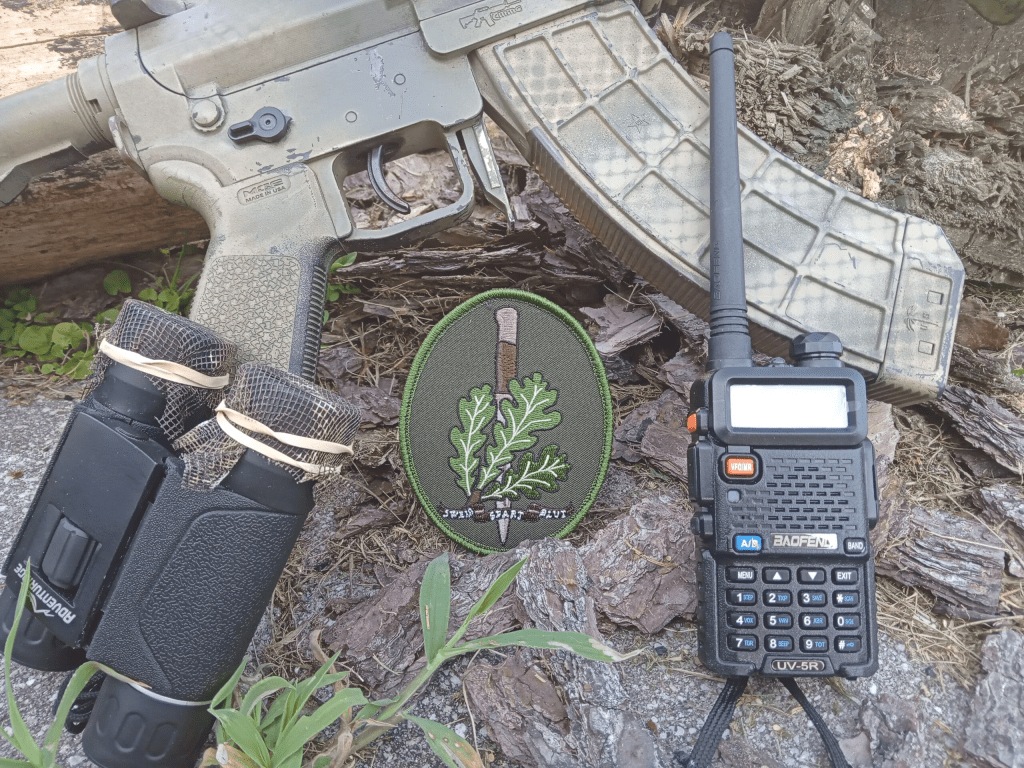
The (now iconic) Baofeng UV-5R

Radio Communications Equipment

Radios are incredibly useful for coordinating multiple teams or reporting back to a TOC or Patrol Base. And when you can still get cheap Baofeng radios on Amazon for under $30 each, there’s no excuse not to have a couple on hand. Bear in mind, not everybody should have a radio on a team if they don’t have something important to say. Too many people with radios will clog up the airwaves, and too much traffic will get you found by someone with even a basic SIGINT capability. Give radios to team leaders and squad leaders to coordinate maneuvers and keep the radios on low power to minimize your electronic footprint. While you’re at it, go to a class where you can learn how to use those radios more effectively.

View through night vision (left) and night vision paired with a Clip-on Thermal Imager (COTI).

STANO Equipment

STANO stands for Surveillance, Target Acquisition, and Night Observation. STANO assets enhance your ability to observe an area and detect people (friendly or otherwise) from an observation post or on the move in a patrol. This includes binoculars, night vision, thermals, and periscopes.

Binoculars: Field Marshall Rommel was once asked what his most powerful weapon was, to which he responded “binoculars.” A good set of field binoculars is very useful for getting a closer look at things, especially when operating in an AO with lots of open spaces. While you may have scopes on your rifles that also provide some zoom, it is a good idea to have an option for observation that doesn’t involve you aiming a weapon at people to get a closer look at them. While there are several cheap sets of pocket binoculars available, they far too often have a very small objective lens, which makes them significantly less effective in low light. However, their size and weight still makes them a good tool for a foot patrol. For an observation post, you’d want to get something bigger with more magnification and wider objective lenses.

Night Vision: As I mentioned in my article about individual equipment, having the ability to see and fight at night is such a massive force multiplier that I recommend selling your extra rifles to buy just one of them. I include it in this article about team equipment because, if you have the ability to do so, getting a few extra night vision devices to share should you need to use them is something that you should consider. It’s also helpful to have them available as backups if your main NVG gets broken, lost, or captured.

Thermals: While night vision devices are useful for getting around and aiming weapons at night, thermal optics are extremely potent for detecting and locating targets via their heat signature. Sure, the ability to see at night is a huge advantage, but it doesn’t change the fact that conventional camouflage techniques for daytime use still work at night against night vision. Thermal optics largely remove this shortfall by reading heat signatures of warm bodies, weapon barrels, and recently used vehicle engines, even through smoke, fog, and light foliage. Thermal optics can be weapon mounted, but for the same reasons as with binoculars, it is a good idea to have a handheld option as well.

Periscopes: The ability to observe something without exposing your head may or may not be important to you, but it is a good option to have if you need it. Handheld periscopes are especially useful in urban environments where it is very difficult to hide the distinct silhouette of a human head. These can be homemade using a tube and two mirrors, or you can try to find an old Soviet trench periscope. S2 underground made two very thorough videos about trench pericopes and their utility here and here.

To be continued…

Next week, Part 2 will focus on resources that will not just enable, but sustain your operations for however long you need.  In the meantime, make sure that you have the requisite skills to use this equipment effectively.  If you want to test your gear and your ability to use it, bring it to a class.

To learn how to make a training program for your teammates, come to a Team Leader Class where I teach how to be an effective small unit leader.  I’m continually adding classes to my training schedule, so be sure to check it once in a while for more class offerings.

Team Leader II Class and Force-on-Force Lab in March; Von Steuben Training

Good morning patriots!

I am pleased to announce the first Force-on-Force Lab event is now on the training schedule for March 26-27, 2022.

Force-on-force is a term that describes an exercise consisting of a battle between two opposing wills.  In this event, participants will be split into two squads and given a series of tactical scenarios with an objective.  It will then be up to each squad to determine how they accomplish their mission within a given amount of time.  Participants will be using blanks in their rifles to simulate the sounds, sights, and smells of combat.

This event will be tied in with Team Leader II, a 3-day sequel to my Team Leader Class.  While the first class covers basic team organization, training, and leadership, Team Leader II is focused on mission planning and tactics.  Students will receive one day of instruction on tactical planning, and the remaining 2 days actually leading a team in the Force-on-Force Lab.  Through repetitive, raw practical application, these students will leave with a solid foundation of knowledge and skill required of a combat leader.

For participants, the Force-on-Force lab isn’t just class.  It’s an opportunity to experiment with different approaches to tactical problems.  You can spend all the time in the world theorizing and reading about how to survive on a battlefield, but this event is an opportunity to truly find out what works and what doesn’t.

You will learn strengths and weaknesses of your tactical equipment.  You will discover just how physically demanding combat is.  You will run through scenarios both day and night to fully understand the challenges of each.  Most importantly, you will get experience operating in a team, coordinating your fire and movement with other shooters.

The scenarios are realistic and require a measured, tactical approach.  Respawn is either non-existent or CASEVAC based, to highlight the seriousness of what you are training for.  Participants who try to go “Rambo” on their own will not do well.  You will need to to balance aggression with caution to achieve victory.

This event is also an opportunity to experiment with your force-multiplying equipment.  Participants will be allowed to use any and all force multipliers they have, provided they do not pose a hazard to other participants.  This includes:

  • Radios
  • SIGINT equipment
  • Night Vision/Thermal optics
  • Drones
  • Smoke Grenades
  • and more!

The price for Team Leader II is $200, the FoF Lab is $300, both together are $500. Space is limited, so don’t delay in registering!

I’m also putting the finishing touches on a “Support Weapons Class,” covering the use of automatic rifle and anti-materiel rifles, to be offered this coming year, so stay tuned!

If you have questions about the event, or to register, send me an email at vonsteubentraining@protonmail.com.

Schweiss Spart Blut

Mike

Ohio Team Leader Class

We are getting close to the registration deadline for the Ohio Team Leader Class on December 11-12!   The class is still wide open for anyone who wants to tough it out in the cold with me for some good training.  Email me at vonsteubentraining@protonmail.com to register.

The Team Leader Class is a 2-day non-firing course of instruction designed to teach students to be effective small-unit leaders. You will learn how to organize effectively into fire teams and squads, and how to take full advantage of commonly available, specialized weapons. We will cover how to use team-based training to mold a group of willing volunteers into a cohesive fighting force. Finally, you will lead a team of fellow students in a series of battle drills to get the experience you need to apply what you’ve learned on your own.

Topics covered include:

  • Task organizing a team
  • Fire and Movement (day and night)
  • Fire and Maneuver
  • Neighborhood/retreat defense
  • Patrolling basics (day and night)
  • Mission planning
  • How to make a training plan for your team

No previous experience or knowledge is required to take this class.  Once again, this is a non-firing course of instruction, so you don’t need to dip into your precious ammo supply for this training.  I have several course reviews up on my website by students from past classes.

The cost of the class is $250.  Again, email me at vonsteubentraining@protonmail.com to register.  The deadline to register is December 4th.  Get out here and get trained!

How to use Airsoft for Training

Now hold on, I can already hear the stampede of “It’s MILSIM bro!” guys rushing to fight the “useless toy guns!” crowd in the comments. I’d like to preface this article by saying that I don’t fall into either of these categories. I know better than to refer to the sport of playing airsoft as “MILSIM.” However, I also recognize that there is potential training value in these “toy guns.”

Strengths and weaknesses of airsoft guns

Before I go into how to use airsoft guns for training, we must first analyze what they can and cannot do. For a start, airsoft guns can be easily configured to be exact replicas of almost any firearm in the world (or in your gun safe). This allows you to “clone” your own guns so that you can build the same muscle memory with your airsoft gun as with your defensive firearms. The magazines are the same dimensions as the real thing too, so you can (and should) use your normal load-bearing gear to carry them.

My Mk47 Mutant (bottom) and airsoft clone (top).  The foregrip is in the exact same place and they both have 3x optics with similar reticles, so I still get practice acquiring targets up close with the magnification.

Airsoft guns are also great for avoiding potential legal repurcussions of getting caught training with actual firearms in certain locations. For example, you and your teammates want to practice patrolling in the local forest and some Karen walking her poodle calls police on you because you look scary. Police show up and start asking questions about what you’re doing, and you can innocently say “we’re playing airsoft.” Just make sure that you don’t paint over the orange tips on your guns.

The best strength of airsoft guns is their utility for force-on-force training. You squeeze the trigger and a small plastic BB is fired at about 400fps which stings your opponent and lets him know that he is hit. I would argue that this is better for force-on-force than simply using blanks because you get to see what actually works and what gets you “killed.” You become more conscious of cover and concealment when there are painful consequenses for carelessness.

All that said, we must recognize that airsoft guns have some pretty hefty limitations on their realism. First of all, the maximum range of most airsoft guns is 100-200ft, which means that the force-on-force utility is limited to those ranges. Second, there are certain aspects of firing a real weapon (muzzle flash, sound, and recoil) that airsoft guns cannot mimic. And third, the fact that they shoot plastic BBs means that a lot of materials provide “cover” from airsoft guns that wouldn’t stop real bullets, creating the potential for training scars.

How to train

Now that we understand what this tool is capable of, I’ll provide some tips on how to employ it in your training.

  1. Force-on-force in dense forests and suburban terrain. This is where airsoft truly shines as a training tool. Avoid a training area with open areas in excess of 100 yards across so you don’t get used to dismissing enemies as “out of range” when you could easily hit them with a real rifle.
  2. Limit everyone involved to semi-auto fire only.
  3. Most airsoft guns have magazines with grossly unrealistic capacity, ranging from 50 round mid-caps to 600 round hi-caps. Stick with mid-cap magazines and load them to a more realistic 30 rounds instead of filling them.
  4. When “hit,” take note of where you are hit and walk through the steps you would take to save your life as if it were a real gunshot wound. Apply a tourniquet if you are hit in a limb.
  5. Plan structured events where each side has a realistic objective rather than an unstructured free-for-all. For example, have one team plan a raid to capture supplies, and tell the other team that they need to defend them. Have them coordinate their actions and fight as teams.
  6. Do not respawn individuals, respawn groups of individuals and require them to function as teams. This encourages collaborative play and keeps the event organized.
  7. Public airsoft fields can be used too, but with far more limitations. If you go to public events keep in mind that most of the other people are there to play a game, not get realistic training. Don’t be a jerk and ruin their day trying to boss them around, you’ll only earn yourself some angry looks and maybe a “friendly fire” incident.

Summary

Airsoft can be a potent training tool if used correctly. As long as you take into account its limitations and plan accordingly, you can get a lot of valuable training for very little monetary cost. A quality electric airsoft gun will run you about $150-$200 including batteries, magazines, and chargers. 5000 BBs costs $15-$20, so it’s extremely cheap once you get past the up front costs.

In the future, I plan to run Force-on-Force Labs through Von Steuben Training, so keep an eye out in the future for these realistic training exercises. If you want to learn how to coordinate and lead a team of shooters, join me in Ohio on December 11-12 for the next Team Leader Class. I look forward to training with you!

How to Use Shooting Competitions for Training

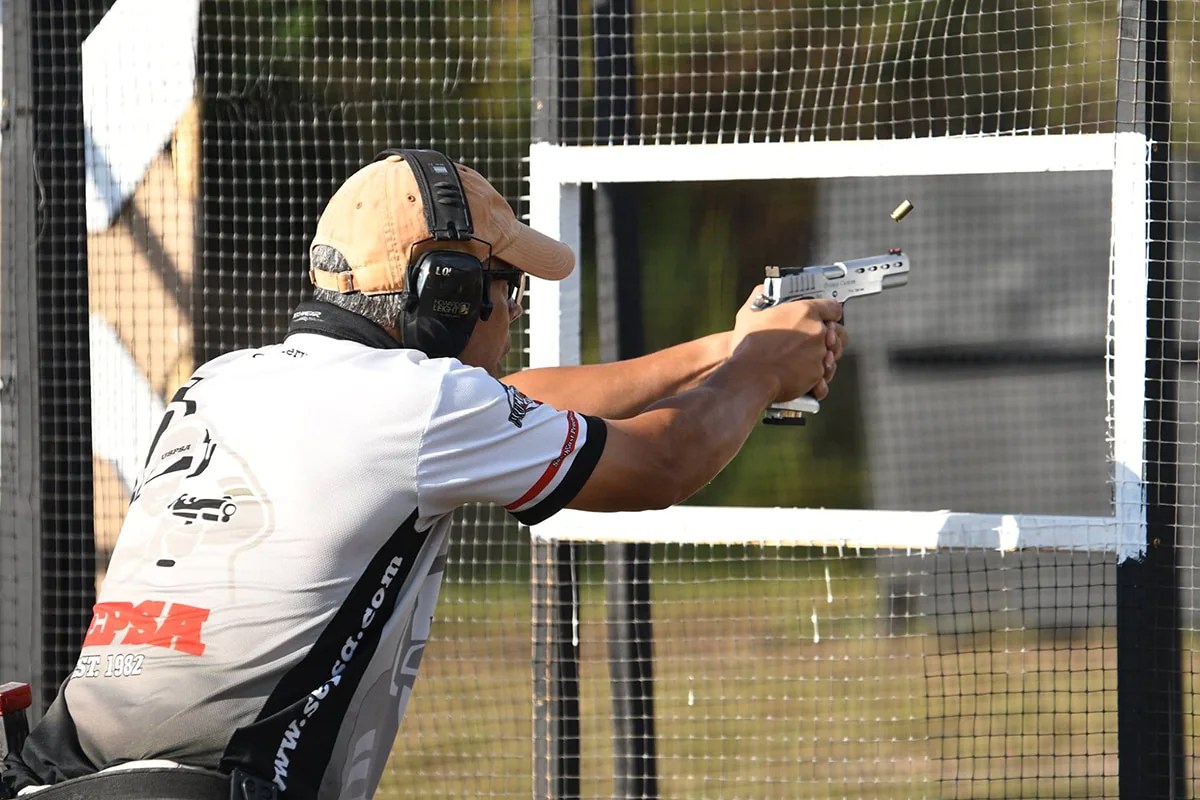
Shooting competitions come in many different forms. Cowboy action matches, USPSA pistol matches, run and gun events, etc. Using competitions to improve shooting skill is a wonderful American tradition. However, there is a tendency in the competitive shooting community to lean very hard into the competitive aspect at the cost of realism or training value. Unfortunately, having what it takes to win a competition does not mean you have what it takes to win a gunfight.

That said, competitions are still a great way to build shooting skill if you do them correctly. Here are my tips for how to get training value out of competitions.

Tip #1: Don’t try to win

This is probably going to shock a lot of people. “What’s the point of a competition if you aren’t going to compete?” you ask. Remember, you are using competitions as training events. The objective is to train well, not to win. Competitions (especially those with time-based scoring) are often set up in a way that the highest score is attained by not using good tactics. Therefore, getting the most training value out of a competition means that sometimes you will need to do things that will make you slower.

I’m not saying that you shouldn’t try to shoot well, just that you shouldn’t get hung up on your score. Once you get this out of the way and put your pride aside, then you can move on and focus on what’s really important.

Tip #2: Use your “real world” firearms

Many people fall into the temptation of making or buying a “race gun” that is designed to give them an edge in competitions. These tend to be very lightweight and may shoot low-recoil ammunition for extremely fast follow-on shots. However, this tends to come at the cost of reliability and combat effectiveness.

Light and fast, but would you trust your life to this rifle?

We’ve all heard “train like you fight,” and it rings true here. If you can shoot faster with the .22LR but your “patrol rifle” is an AK, why wouldn’t you want to get better with the rifle that you trust your life to?

This also goes beyond simply building skill with your “real world” firearms. Competitions are great places to learn what works and what doesn’t work on your weapons. During one match, I discovered that a certain type of ammunition gave me stuck casings repeatedly when the gun warmed up after firing 20 rounds in under a minute. I would never have discovered this issue plinking away slowly at 200m on a square range.

Bottom line, you need to be training with your actual defensive firearms. “Race guns” are counterproductive and a waste of your money.

Tip #3: Use your “real world” equipment

This goes hand-in-hand with the previous tip. By “equipment” I am referring to your load bearing gear, slings, magazine pouches, and clothing. For example, it makes no sense to practice reloading from open-topped magazine pouches when your “minuteman kit” has flaps on the pouches.

Many people are hesitant to wear their combat gear to a competition, and with good reason. When everybody else is wearing polo shirts and jeans, showing up wearing a helmet, plate carrier, and multicam head-to-toe will draw some weird looks. This is not what I’m suggesting that you do. Wearing normal clothing with your belt/LBV/plate carrier is not that uncommon at most events, as long as you take the context of the competition into account. 2-gun or 3-gun matches have a lot of people wearing vests of some sort to hold all their ammo, but a long-range marksmanship match won’t. Of course, if you want to wear a plate carrier to get used to shooting with it on, this is still America and you can do what you want.

“Real world” equipment can also mean that you wear less gear. Most people at pistol matches wear a war belt to hold their holster and ammo, but this is unrealistic. Very few of us do this on a daily basis, so it doesn’t make sense to train like this. Instead, for pistol matches, try to carry your gun in the same holster and the same clothing that you use for concealed carry. Not all events will allow you to do this, but if they do you should take advantage of it. Draw from concealment when you can. If you carry an extra magazine in your pocket, reload from your pocket instead of a pouch on your belt. This will cost you some time, but as I stated in tip #1, speed is not the goal here. Training is.

Tip #4: Go for accuracy, not speed

I’ve been to matches where guys who sprayed rounds at the targets and missed a lot scored much higher than those who shot the match “clean” with no misses. While speed is conducive to your score, accuracy is more beneficial for your survival. It’s a bad habit to fire three shots at a target and then move on to the next one without checking to see if you hit it or not. It’s especially bad to practice spraying rounds at a pistol match when you consider those actions in the context of self-defense with a handgun, and that you are responsible for each bullet you fire no matter where it goes.

Take your time, get accurate shots on target, and eventually the speed will come naturally. It is better to hit slowly than to miss quickly.

Tip #5: Take a friend

Having someone else to critique your shooting is incredibly helpful for seeking self-improvement. There is only so much that we can correct purely on our own, so having a friend that you trust to watch you and give you corrections is a great asset. Even better if they record videos of you so you can look back and see what you are doing wrong. Plus, shooting is always more fun with a friend.

Conclusion

Shooting competitions are great opportunities to improve your firearms skills, and they can be even better opportunities if you make them. If you can put aside your pride, forget that you’re at a competition, and handicap your score in exchange for better training value, you will see marked results in your real-world skills.

Speaking of training, I have classes on the training schedule. If you want to move beyond your individual skills and learn how to work within a team, register for a class and I’ll get you squared away. Email me at vonsteubentraining@protonmail.com.

Team Leader Class AAR and Future Plans

Two weeks ago I had the great pleasure of running another successful Team Leader Class.  I was honored to have Timbersour in attendance, and he wrote a great course review that I posted yesterday.  I am constantly modifying and adding to the course to improve the quality of the training.  At the end of every class, I run through a series of after-action points with the students to get input on what to sustain, what to improve upon, and what to get rid of.  Here are some of the bullet points from the July 10th TL class.

  • I added a night vision familiarization portion to the Friday night prior to the rest of the class.  Students brought their own night vision devices or borrowed mine for this.  We practiced walking around under NVGs, both on a flat road and through the woods, and for some of the students this was akin to getting their “sea legs” so to speak.  We also demonstrated use and utility of IR lasers, how they look from downrange, and how to use them against a night vision-equipped adversary.  Finally, we took our camouflage clothing and tactical equipment and discovered how it looked through night vision (i.e., how effectively we could hide from night vision).  This portion of the course was an overwhelming “sustain” and I intend to make it a permanent part of the course going forward.
  • During the course, I briefly touched on defensive principles and defensive positions.  Some of the students said the class could be improved by devoting more time to this topic because of how useful it would be for defending a neighborhood or rural retreat.  This being the second time I received such input, I have decided to listen and will cover defensive principles in depth in future classes, including an interactive defense exercise.
  • The drills we practice during the class are done with the students’ personal rifles, unloaded for safety.  One student suggested using airsoft guns for cheap force-on-force practice, and to avoid certain legal ramifications of training/travelling with firearms.  I’m still working out how to fit this into the scope of the Team Leader Class.  I may eventually run a multi-day force-on-force training event in the future if I get sufficient interest and a suitable location.

In order to accommodate these and other changes, I am extending the class to a 2-day course, beginning Saturday morning and ending around noon on Sunday.  The Night Vision familiarization portion will be optional for students who choose to arrive Friday evening.  Going forward, the Team Leader Class will be structured as follows:
Friday (optional):

  • Early students arrive in the afternoon/evening
  • Night Vision familiarization

Saturday:

  • Remainder of students arrive, class starts at 0900
  • Part 1: Know your team
  • Part 2: Train your team
  • Fire Team level fire and movement drills (day and night)
  • Defensive Fundamentals
  • Patrolling basics (day and night)

Sunday:

  • Lesson: “The Godly Warrior” (optional)
  • Part 3: Lead your team
  • TDG exercise
  • Squad level Fire and Maneuver
  • AAR

The next Team Leader Class is scheduled for October 30-31.  I will post future classes on my training schedule. For more information or to register, email me at vonsteubentraining@protonmail.com
Schweiß spart blut.
-Mike

July 10th Team Leader Class

We’re just under a month away from the next Team Leader Class on July 10th, offered through my business VonSteuben Training & Consulting. For those of you who missed the previous announcements, I’ll briefly summarize what I teach in the class. Additionally, WWes wrote a pretty good course review from the test run of the class back in February, so you can check that out as well.
If you’re reading American Partisan, it’s probably safe to assume that your mind’s already in the right place as far as training goes. You may even have a group of like-minded friends in your local area that you plan to rely on should SHTF, and if you do that’s awesome. However, it can be hard to motivate all of your friends to spend the time, money, and ammo to go to courses, so how can you get them the training they need for you all to be effective? The answer is simple; YOU have to train them.
This is where the Team Leader Class comes in. My goal is for you to leave my class with the ability to train your friends back at home effectively and efficiently, and at as low a cost as possible. You will have the knowledge and confidence necessary to plan, lead, and conduct training with your buddies to forge them from a “group” into a cohesive “team”.
Now that the mission statement is in the clear, I’ll go over the details of the class itself. The TL class is 1 full day of training, starting at 9am and ending around 4-5pm depending on class size. I will teach you how to effectively organize a group into fire teams and squads and how to utilize any special weapons you may have or come across. We will cover how to use progressive team-based training to mold a handful of volunteers into a lethal fighting force. Finally, throughout the day you will lead a team of fellow students in a series of battle drills, learning the dynamics of a gunfight and getting the experience you need to apply what you’ve learned on your own.
Full disclaimer, there is some physical activity involved in this class for the battle drills. Expect to run short distances, getting up and down a lot to kneel/lie behind cover.  You will probably get muddy/dirty too, so dress accordingly.  I’m not going to slay your body, but you will get a bit of a workout in. Combat is physical, training should be too.
The gear list is posted here on my website. There is zero, I say again ZERO ammo requirement for this class. The reason for this is twofold. First, given the current ammo shortage, I want to lower the barrier for you to get the training that you need. Second, I want to show you that you can train your teams without burning anyone’s precious rounds that you might need in the not-so-distant future.
The location is in Eastern NC in the New Bern area. The class registration fee is $100 per student, paid up front. If you have to cancel after paying the registration fee, I will grant you a slot in a future class. This is to ensure that I do not waste your time driving out to a team-based class where everyone else backs out last minute. To register or get more information email me at vonsteubentraining@protonmail.com.  If you want to attend a future class, I have another class in October posted on my training schedule.  I look forward to training with you.
Semper Paratus, Semper Discens, Semper Fidelis.
-Mike

The Mission Profile

I want to approach a related topic that pertains to your own mental preparedness, the mission profile.
Your mission profile is, simply put, a list of mission/operation types that you anticipate having to conduct in the future. This will vary greatly from group to group, as we all have our own unique set of scenarios that we forsee ourselves in, and we prepare accordingly. For example, a neighborhood protection team organized to defend against rioters/looters will have a vastly different mission profile than a militia in a rural area preparing to fight an occupying army.
However, mission profiles that exist merely in our heads are useless because not everybody in your group will be on the same page. Sure, your neighborhood protection team all understand that your goal is to protect your homes and families, but everyone has different ideas about what exactly that entails. Setting up checkpoints? Internal patrols at night? What about security patrolling outside your perimeter?
The point I’m trying to make is that everyone in your team needs to be on the same page with what exactly you are preparing to do. The only way to do this is to sit down with every member of your team and a whiteboard, and discuss exactly how you plan to accomplish your mission in the future. There will be disagreement, even debate as you discover that not everybody is on board with the idea of patrolling 10 miles and staying in the field for a week at a time like you envisioned. Be respectful, be polite, and have good reasons for what you propose. Listen to your people, they probably have legitimate concerns that you hadn’t thought of. Once all is said and done, you will all walk away with a common vision and clear goals for your training and preparedness.
Once you have this talk and everyone is on the same page, you can begin to craft a training schedule that supports your mission profile. You plan to establish observation posts watching a nearby intersection? Spend a Saturday in your “OP” documenting the traffic that passes by. You want to use vehicles for covert team insertion/extraction? Practice doing that, coordinating with your driver over radios. Make your own TDGs for your mission profile, and wargame both sides.
We can only accomplish so much on our own, gentlemen. Make sure you have clear and common objectives so you can train your people effectively for what’s headed our way.
Schweiß spart blut

Priorities of Purchase; Progressively Building a Rifleman’s Kit on a Budget

This article is not for most of you readers, as you probably already have at least a basic understanding of what gear you do and don’t need. I am not writing this article for you, I am writing it so you can show it to your friends who are just breaking into the realm of preparing for the coming fight, and need a little guidance. At the very least, read it so you can make recommendations to them so that they will be assets, not burdens, when you eventually strap up and take them on a patrol.

WARNING: Opinion

If you’re just starting out into prepping and you’re looking to build up a fighting kit, all of the info out there can be pretty overwhelming. The natural tendency is to focus on the cool-looking points of your gear, but this can be counter-productive, especially when you have a fixed income. For example, it’s natural to immediately buy an AR with a bunch of accessories, and maybe splurge on a high-end plate carrier and plates because that’s what you see all the “cool guys” wearing, and you need body armor right? The problem is that you just spent a ton of money on your rig, and you haven’t invested into some other basic things you need to sustain yourself during operations, like a good pack, ammo, or even canteens.
In this article I will list the purchasing priorities for building a rifleman’s kit piece-by-piece, so that you can efficiently build up your gear and yourself to be as ready as possible for when it’s time to defend yourself and your liberties. I am trimming away all of the tacti-cool fat and unnecessary gear so you can make the most out of your limited budget and keep your priorities straight.
I must note here that this is not a post about prepping. Things such as alternate energy, homesteading, and water purification are indeed important, but are beyond the scope of this article and my expertise. Perhaps someone more knowledgeable than I could write up a similar article along those lines later on. I am writing purely from the perspective of someone who is gearing up for a potential civil conflict/WROL scenario looking to make themselves an asset to their family, their team, and their country. Again, everything you’re about to read is my personal opinion based off my experience, feel free to disagree with anything I say.
 

Rifleman’s Essentials

This is the bare minimum of what you need to be proficient in a firefight, and thus where you should start.
The first step is simple, as a rifleman you need a rifle. Notice I said a rifle, not a rifle with a scope, laser, bipod, and flashlight, those are much further down the list. I’m talking about a bare-bones rifle with iron sights AND THAT’S IT. For now.  Also note that rifle was singular.  It’s better to have one rifle and a full kit and ammo than ten empty weapons collecting dust. There’s too much that goes into weapon selection to cover here in depth, so I’ll be brief. Your rifle should if possible meet the following criteria:

  • It should be easy to feed. 6.5 Creedmore or .300 BLK are neat cartridges, but you can’t afford to be paying over a dollar/round. These days the best choice is probably 7.62×39, which can still be had for 40 cents per round. This is, however, a call you should make yourself. If magazine-fed it should use affordable, commonly available mags.
  • It should be reliable. There’s a lot of gimmicky weapons out there, try to stick with combat-proven platforms that don’t have a tendency to go click when you need them to go bang.
  • It should, if possible, be matched to your environment and mission profile. To determine this you will need to consider how you will be operating. At what distance will you most likely engage targets? Will you need to make shots through brush, or is your terrain more open? An accurate survey of your surroundings will determine factors such as caliber, barrel length, etc.

If you have a limited selection, any rifle is better than no rifle. Even if you have a bolt-action Mosin-Nagant or a hunting rifle, you can be effective with it if you train accordingly.
Next you need the ability to feed said rifle. You should purchase 1,000 rounds of whatever caliber you are running, put it in sealed ammo cans, and DO NOT TOUCH IT. This is your emergency reserve, you only pull it out if you need it to protect life, liberty, and property in SHTF. Buy in bulk online for the cheapest prices. Any ammo you buy beyond this you can shoot in training.
Also in the realm of feeding your rifle, you need additional feeding devices (magazines, stripper clips, enblocs, etc.). For a start, you need to be able to carry at least 120 rounds on your person plus whatever’s in the gun, so at a minimum 5-6 magazines or that equivalent amount in stripper clips. If you can get more, get more. You can never have too many magazines, but at this point 5-7 will suffice.
Now you need a way to carry all those magazines on your body, so you should get some kind of load-bearing gear. There’s a ton of articles, videos, and posts about different kinds of kit so I won’t go too in-depth here. Suffice to say that you don’t yet need body armor, just a way to carry your combat equipment and ammo.
Medical equipment is next. You need a trauma kit to quickly mitigate life-threatening injuries so you can survive the trip to the hospital/casualty collection point. You need items like quick clot, bandages, chest seals, etc. in your IFAK somewhere on your gear. You also need tourniquets, 2-4 of them. Get the same type so you only need to practice one way, and then get an extra one to practice with. Make sure your IFAK is somewhere you can easily acces it, i.e. NOT on your back.
You need a way to carry water on your load-bearing kit. You won’t last long in combat operations without water, so you need to have some on your gear. Camelbacks work great, but make sure you have extra bladders in case it pops. Canteens work as well, but if that’s all you have then you will need to get used to drinking a whole one-quart canteen all at once to prevent a half-full canteen from sloshing and making unwanted noise. It is possible, Marine Recruits do it every night in boot camp before going to bed.

Sustainment Gear

Now that you have all the Rifleman’s Essentials, you need to have the ability to sustain yourself in combat operations for a few days or even weeks. Sustainment gear satisfies basic human needs for survival such as water, food, and shelter, to keep you alive during extended periods of time in the field. For our purposes, we will assume a 1-week field stay without resupply.

First and foremost, you need a pack to carry everything. There’s a ton of models out there, so let me save you some trouble. Get a medium ALICE pack, preferably with a frame. It’s simple, been in service with the military for decades (even though no longer issued, trust me it’s still in use), and is big enough to hold everything you need without a lot of extra space. It’s also much cheaper than newer packs of comparable size and durability, making it ideal for the budget warrior. That’s my recommendation, do with it what you will.

If you haven’t already, get a sling for your rifle. Slings are useful for saving your arms during long patrols, stabilizing the rifle in a prepared firing position, freeing your hands for other tasks, and keeping accountability of your weapon so it’s ready to go at any time. Get an easily adjustable 2-point sling, single-points are only good for CQB and in mounted vehicle operations. My personal go-to is the Blue Force Tactical Vickers Sling, but there are other good ones out there.

The first basic human need for survival is water. You cannot carry enough water in your pack for a week’s worth of combat operations, so you need a way to purify/filter water in the field. I highly recommend Sawyer Mini water filters. They’re small, weigh almost nothing, re-usable for more water than you will ever drink in your life, and only cost about $20 each. You should also have about half a gallon more water in your pack in addition to what’s on your gear, so two additional canteens will do nicely.

The next basic human need is food. Technically, you can survive for 40 days without eating before facing any permanent harm to your body, but you’re not planning on merely “surviving” are you? We’re talking about combat operations, and whether it’s patrolling, manning an observation post, or getting into gunfights, there’s a lot of physical exertion involved and you need calories to keep going. If you can get them, military MREs are a great option that is lightweight, compact, and calorie-dense. Plan on eating 2 per day, field strip them, and put them in your pack. If you can’t get MREs, there are similar options on the civilian side of the house, Mountain House being a great one. Canned chilis and soups are also decent options if you have nothing else, but they get heavy. Camp stoves, while nice and compact, are luxury items. Up to you if you want to spend your money on one, but if we’re trimming all the fat, save your money.

The final basic human need is shelter, or protection from the elements. This will vary greatly depending on your environment. If you live where it gets chilly at night, you will need a compact sleeping bag. If you’re further north you will need two sleeping bags, a lightweight one for summer and a heavier one that can stand freezing temperatures. If you live further south, you can probably get away with just a light blanket or even no warming layers at all in summer. If you live in mosquito country, you may choose to invest in a bug net for sleeping in just your clothes.

Unless you live in an arid climate, you will have to contend with rain at some point. During the daytime this may not be an issue, but being wet and cold at night trying to sleep is miserable, and could be lethal if you get hypothermia. Invest in a military surplus GI poncho or tarp, and learn how to make a Royal Marine Rig or lean-to out of it. Sleeping under a tarp may not be appealing to many, but it is well worth it not to carry around a tent everywhere. You will probably also want a sleeping pad, both for comfort and to keep your sleeping bag dry and out of the mud. Sleeping pads are also a lifesaver when you’re resting on your elbows for hours in an observation post.

Speaking of rain and mud, you will need some kind of rain gear to wear with your kit. Rain jackets, like Gore-Tex, are probably your best bet. Ponchos work but not with every type of load-bearing gear.

A great tool to have for field living is a good fighting knife/bayonet. Besides poking the blood out of people, a large (5”-8”) fighting knife can be used for a huge number of tasks in the bush, such as building a shelter, preparing a fire (tactical situation permitting), opening cans, cleaning fish, etc. Trust me, you won’t regret having a good knife somewhere on your kit.

Force Multipliers

Once you have the Rifleman’s Essentials and the ability to sustain yourself for up to a week during operations, then you can begin investing into force-multipliers. Force-multipliers are so called because they are tools which greatly enhance, or multiply, your lethality on the battlefield.

  • Another rifleman. Yes, that’s right, you shouldn’t be preparing and training alone, you are much more effective as a member of a team. Even if you just have one buddy working with you, it’s a huge leap in combat ability. Don’t just assume that if a civil war breaks out the militias will come to recruit you, you are the militia. Get a buddy, then get two more, and boom you got a fire team. And if you want to learn how to train up the other members of your fire team effectively, I have a class for that.
  • Night vision. The ability to move and fight at night is a massive bonus, especially for us as civilians. Our friends at Ready Made Resources have a great selection of NVGs at pretty decent prices, so go check them out. Now, be cautious here. You will need to save up a few thousand dollars to get a good quality night vision unit, and this will take time. You will be tempted to spend your money on other things as you save up, RESIST THE URGE. If you constantly say to yourself “yeah, I need night vision, but I can buy body armor and a cool scope right now,” you will never get your NVG. This needs to be a priority, so be patient.  This is such a high priority that I’d even recommend selling any extra weapons/gear you have to get night vision sooner.  I did, and have no regrets.
  • IR laser. Once you get your NVG (yay!) you will next need a way to aim your weapon using it. The most common way to do this is with an IR laser mounted on your rifle. There are a ton of expensive lasers out there, most of which cost over $1200. I highly recommend ordering a Perst-4 out of Russia. At $450 it’s a cheap, rugged military laser with great ergonomics, with the added bonus that it’s a full power class 3 laser.
  • Radios. Absolutely necessary if you plan to coordinate a large squad, or work alongside another team. With radios you can call for medevac, send tactical reports, and coordinate with an extraction team. Baofeng UV-5Rs are pretty good for the price, get a couple of them so you have somebody to talk to. Eventually you may choose to get a more advanced radio, but keep the Baofengs for your friends and teammates to borrow. While you’re at it, get trained so you can make the most out of your investment.

Once you have these investments out of the way, you can begin to add little bits and pieces to your gear as you train and find out what works for you and what doesn’t. Get to a training course where you can experience running your kit and find out what changes you need to make. Grab your sustainment pack and go camping with it for a couple days, see how it works for you. The more you train and practice using your gear, the more context you get for how to make practical investments in equipment that is useful and not just “cool looking.”

Additional Investments

I would like to add a few final notes on some other pieces of kit that you will at least consider buying during your journey, to put them into context as to their actual utility.

  • Body armor: Good kit, will stop incoming rounds to vital areas of your body. However, this must be weighed against the fact that it is heavy and uncomfortable, so you should do a realistic evaluation of your level of physical fitness as well as your mission profile. If you plan to wear body armor, plan to do a lot of workouts with it on. Don’t just look at yourself in the mirror and take it off, wear it for a couple hours walking around the house. Go for a run with it on. If you can’t run/jog 3 miles with your armor on without stopping, you’re not ready to use it as your main kit.
  • Ballistic helmet: Same deal as with body armor, protection at the cost of added weight. This time the weight is on your head. If you’re not used to wearing a kevlar helmet on your head for a few hours, I can tell you right now that it sucks. Your neck gets tired, parts of your skull get more pressure than others and start to hurt, and it makes you sweat. The new helmets aren’t immune to this either. I’ve worn LWHs, ECHs, OPS-Core high cuts, and MICH helmets, they all suck. Still a good thing to have, but if you’re gonna plan to use it for the real thing, make sure you use it in training a lot.
  • Optics: Red dots, LPVOs, fixed magnification scopes, etc. Whatever you get you should get for a purpose to enhance your existing skill. There’s a reason I put this so far down the list. If you practice and get good with your iron sights, you will be good with an optic. You will also have better context to decide what kind of optic you actually need/want. Magnification helps with target ID and longer ranges, illuminated reticles assist with aiming in low-light situations. Don’t buy cheap scopes, you get what you pay for with optics. I’ve seen amazon/wal-mart red dots randomly shut off due to recoil and even snap off the rifle during shooting.
  • Fore-grips: There is no objective “best option” here, it is literally user preference for comfort and has little to no effect on your shooting.
  • Weapon lights: Unless you’re on a SWAT team, tac-lights have no place on your rifle, the risk of accidentally hitting the on switch and getting you or your teammates killed is too great. If you do get a tac-light for that 1 in 1,000 chance that you actually enter and clear a dark structure, get a light with a QD mount that allows you to keep it in your pack until you need it, and take it off when you’re done.
  • Other rifle accessories: Before you put anything on your weapon, ask yourself, “does this make me more effective?” If the answer is yes, buy it. If the answer is no or probably not, save your money.
  • Handguns: You don’t need a handgun unless you conceal and carry. The reason is that there is nothing your handgun can do that your rifle can’t do better. The myth that “a transition is faster than a reload” is only true if you suck at reloads. You can better use the weight and space that your holster takes up by holding extra rifle mags instead.
  • Assault Packs: These are actually great for carrying stuff that you’d use on a 1-day patrol when you don’t need everything from your sustainment gear. Ideally, you’d get one that either fits inside or clips onto your sustainment pack. Use your assault pack to hold 1 day’s worth of chow, extra ammo/batteries, and anything else that your specific mission requires. Avoid the ones that strap directly to your plate carrier/vest, as you need to remove your fighting equipment to get anything out of it.
  • Magazines and ammo: This is never a bad idea. You can always use more mags and ammo, and so can your buddies if they’re running the same caliber as you (they should be).
  • Camouflage fatigues: Get a pattern that matches your environment and helps you blend in. If working within a team, try to have everyone wear the same pattern to avoid friendly fire. Keep in mind, however, wearing a “uniform” makes it easier for an enemy to PID you as hostile, but if you’re wearing a bunch of tactical gear with a rifle they can probably PID you anyway.

I hope this helps someone. As I stated at the beginning, everything here is simply my humble opinion, you are welcome to disagree with me in the comments.

Semper Paratus, Semper Discens, Semper Fidelis.