
Over this past weekend I had the pleasure of teaching a 3-day training course to a private group. One unique trait of VSTAC is that I can tailor curriculum to meet the specific training needs of a private group. This group requested the following training modules:
- Day 1: Operations Center and Observation Posts
- Day 2: Patrolling refresher and a 3-hour day/night patrol exercise
- Day 3: Mounted Operations
Training modules available for custom training events can be found on the Custom Training tab.
This is a summary of what we did as well as some After-Action Review (AAR) points to share lessons learned.
Day 1: Operations Center
This was my first time teaching this custom training module, but I had everything prepared and the class went smoothly. Students learned about the purpose of a Tactical Operations Center (TOC), what critical functions are required, and how to do each one. The morning was spent in the classroom with students learning the following skills:
- Manning a radio watch
- Battle tracking bad guys and good guys using various types of map boards
- Coordinating/deconflicting support for subordinate units in the field.
In the afternoon students put all these skills to the test in two Command Post Exercises (CPXs), semi-scripted scenarios where students simulated running a TOC. I had roleplayer support for this exercise, so they had real radio reports coming in from simulated scout teams keeping them informed of the developing situation so they could battle track it and make decisions. They even launched a real drone at one point, flew it to where the “action” was, and I told them what it “saw” when it got there. It was basically a live-action TDG, and it really helped the students get a feel for how all the pieces of a TOC work together.
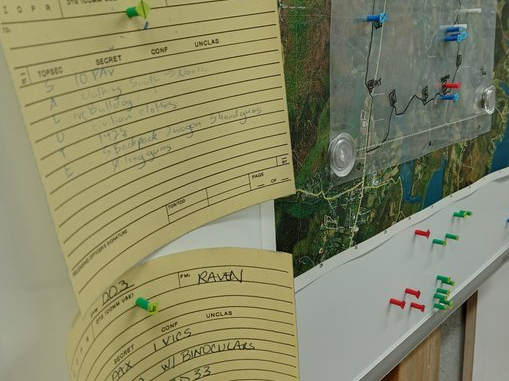
For the first time running this training module, I think it went very well. The group had several women participate in this day of the training, and they all seemed to enjoy the experience. My AAR points from this day are as follows:
- SUSTAIN running this class in this order. Increase the estimated time of this module to 8 hours and lengthen the CPX exercises to maximize knowledge retention of the material.
- SUSTAIN allowing the students to actually launch and fly a drone during the CPX exercise to give them a clear understanding of its capabilities and limitations.
- SUSTAIN using women and your less physically fit personnel to run a TOC during operations. That may not be very PC, but I don’t care. In a crisis, you need to efficiently use all of your resources, and that includes human resources. You need your most physically fit guys out in the field, whether that’s a security patrol or clearing fallen trees from roadways after a tornado. Also, women are just good at radio watch. Walk into any dispatch center in America and you’ll see that they’re 90% staffed by women.
Day 2: Patrolling Refresher and Exercise
Most of the students in this class had attended some kind of patrolling course in the past. This group had requested a realistic patrolling exercise, day and night, on a realistic timeline to get a feel for how a patrol really goes. We spent the morning doing some basic patrolling refreshers and drill rehearsals to ensure that everyone was on the same page.
In the afternoon, I taught the Patrol Route Planning class from day 3 of the Jäger Course. Students learned about considerations for patrol routes and practiced sketching route overlays.

When that class ended, I gave them a rough scheme of maneuver for the evening: a security patrol around the training property. I gave the students a “road to war” scenario, a general concept of the route, a rough timeline for start-to-finish, and turned them loose to plan the patrol themselves. I stayed in the room to answer questions and give recommendations when asked, but for the most part I let them plan the whole patrol using what they’d learned. It was quite a sight to see the student leadership get right to work planning every aspect of the patrol. They even made a route overlay for the TOC, which was actually operating during the exercise.

We stepped on the patrol about an hour before sunset. I chose to embed with the patrol as a “rifleman” so as not to break the immersion of the patrol experience by just walking alongside them. I fell in with their second fire team and stuck close to the patrol leader so I could observe and evaluate his decisions.
They encountered my “civilian refugee” roleplayers first and halted the patrol to observe. There was immediately a breakdown in communication, as the Team Leader who spotted the civilians and halted the patrol failed to inform the patrol leader of why we had stopped. After several minutes, I gave the patrol leader a “nudge” to find out what was going on. Since the civilians weren’t doing anything suspicious and didn’t appear to be a threat, the patrol leader chose to bypass them and continue the patrol.
Eventually the patrol reached an open danger area (field) that they could not bypass. Fortunately they had identified this hazard during planning and had accounted for it. They set 360-degree security and launched a small drone to scout the far side of the field for hostile activity, which found nothing. Once the pilot recovered and stowed the drone, the patrol quickly crossed the danger area using a squad wedge and traveling overwatch.
Once across, we set into a Patrol Base (PB) right at sunset and mounted our night vision while we waited for darkness. Once we passed the end of nautical twilight (when it actually gets dark), we evacuated the PB and began our return. OPFOR ambushed us on the way back right as half the patrol moved across an open danger area.
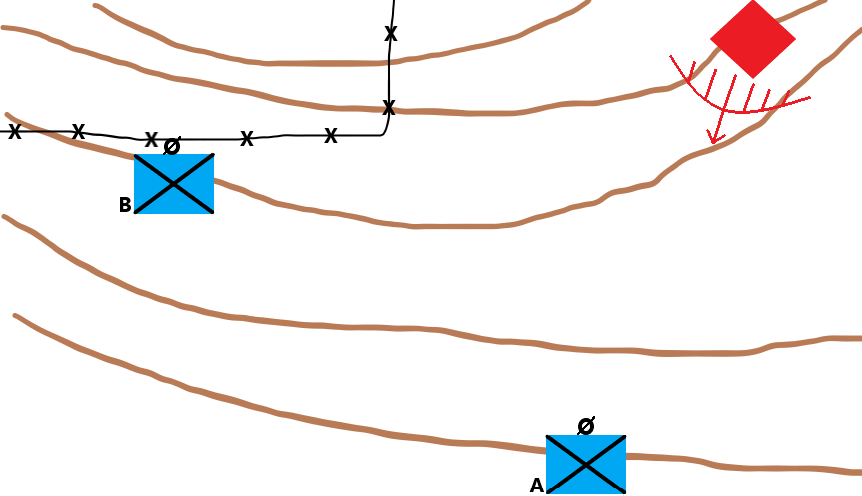
Alpha team was caught in the open and immediately took a casualty. Bravo team turned and attempted to return fire on the ambushers, but the curvature of the hill denied them a good line of sight. Bravo team leader made a snap judgement call and ordered his men to dump their packs and crawl under the barbed wire fence next to them so they could get to higher ground and flank the attackers.
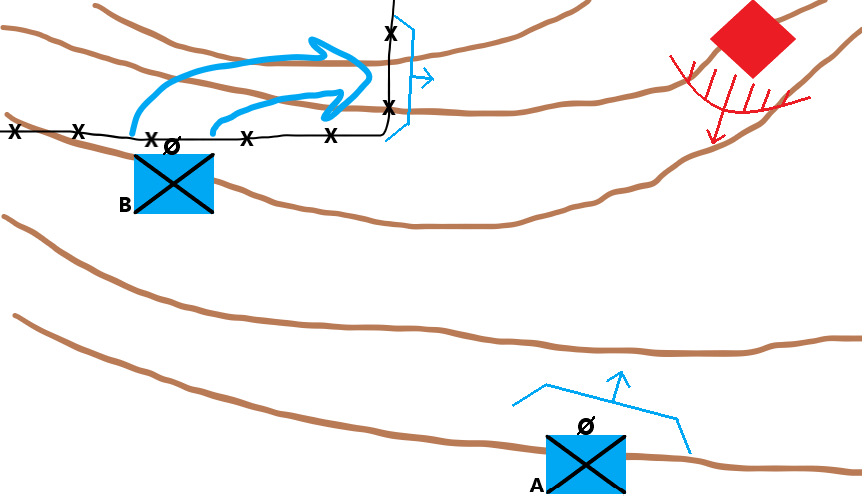
This move caught OPFOR by surprise and forced them to break contact, ending the ambush and saving Alpha team from taking further casualties. Now that the initial threat was over, it was time to focus on consolidating the patrol.
The patrol leader had been located with Bravo team. Alpha’s casualty was their team leader with the radio, so the patrol leader couldn’t get in touch with them. He ran over to their position and was informed that they had taken a casualty. The patrol leader immediately called the TOC and requested a CASEVAC, which was available in the form of a small OHV with a stretcher.
When we heard the blacked out CASEVAC vehicle approaching, the patrol leader signaled our location using an “IR buzz saw” (an IR chemlight on a string swung in circles to make a large bullseye only visible through NV). This group had previously trained CASEVAC loading on their own, and it was impressive to watch how quickly they worked stabilizing and loading up the casualty. When the CASEVAC vehicle departed, we returned to the TOC and ended the patrol.
I can’t take credit for everything these guys did, many of them had already done a good bit of work training together prior to this class. What I had taught them was the planning aspect of this patrol, which they executed nearly flawlessly. From there, all I did was provide a scenario with some semi-scripted events, coordinated roleplayers to execute these events, and controlled the scenario to maximize the training value (and fun) of the experience. They had a LOT of great observations and lessons learned during their AAR before going to bed. Below are a few of my own.
- IMPROVE communication between key leaders on the patrol. The hang-up with the civilians early on caused a delay of several minutes. Team leaders should quickly pass information up to the patrol leader and the patrol leader should quickly disseminate what he knows down to the teams. If the patrol leader doesn’t know what is going on, he should take initiative to find out. This is corrected through repetition and naturally smooths out over time.
- IMPROVE physical fitness of the team. We moved less than a mile through thick vegetation and mild hills, and all but 2-3 members of the patrol were exhausted when we got to the patrol base. We were only wearing LBE with rifles, and the few backpacks that were carried weighed less than 20lbs. The patrol leader chose to be a stud and wore body armor, and he was probably the least worn-out. If the team had been compelled to fight at the end of that movement, it would not have been pretty. This was a very, very short patrol with minimal equipment in mild weather, and was a wake-up call to the students. Go outside and ruck. Get fit or die.
- IMPROVE radio setup on my personal kit. I normally use a Baofeng UV-9R as my “kit radio” that lives on my chest rig. This time I was trying to use an AR-152 to see how it performed. It “worked” when I tested it, right up until the final Pre-Combat Checks (PCCs) before the patrol. I couldn’t get the radio to transmit my voice through my headset, and at that point it was too late to switch radios. I conducted the patrol with the radio in its stock configuration, pulling it out of the pouch whenever I had to use it. I’ve had this same problem before with a different PTT. The flimsy 2-prong accessory connector is likely to blame, despite the ranger band I had holding it in place. I was disappointed, I really want to like this radio, but I can’t recommend it until I solve the reliability issue with the accessory connector.

Affiliate link: https://amzn.to/3BiSXxT
- SUSTAIN/IMPROVE patrol base evacuation procedures at night. Our PB was in some pretty thick vegetation in a wooded area, and we anticipated getting hung up on thorns and such on our way out. I recommended that the patrol leader assign a 2-man team to find and mark a clear-ish path out of the brambles before it got dark. We tried using taped-up chemlights to mark the trail, the tape being to make the light shine in only one direction. This worked, but even the tiny sliver of each chemlight that we left exposed was so bright it washed out our NODs as we exited. The suggestion was made afterwards to use shorter chemlights, or even children’s glow sticks for this purpose.
- SUSTAIN the use of the Binary Automatic Rifle (abbreviate it BAR for fun) as a SAW substitute in the fire team. One man in Alpha team had a dedicated autorifle build with a binary trigger. During the initial contact he did a great job of putting heavy suppressing fire on the ambushers when his team leader went down, keeping the OPFOR suppressed long enough for Bravo team to make their flanking maneuver.
- SUSTAIN casualty marking SOP. My training group uses a red chemlight to mark casualties, and our gear SOP requires us to carry 3 of them in our IFAK. I immediately marked the casualty during this scenario and it was very effective at showing the patrol’s medic where he needed to be.
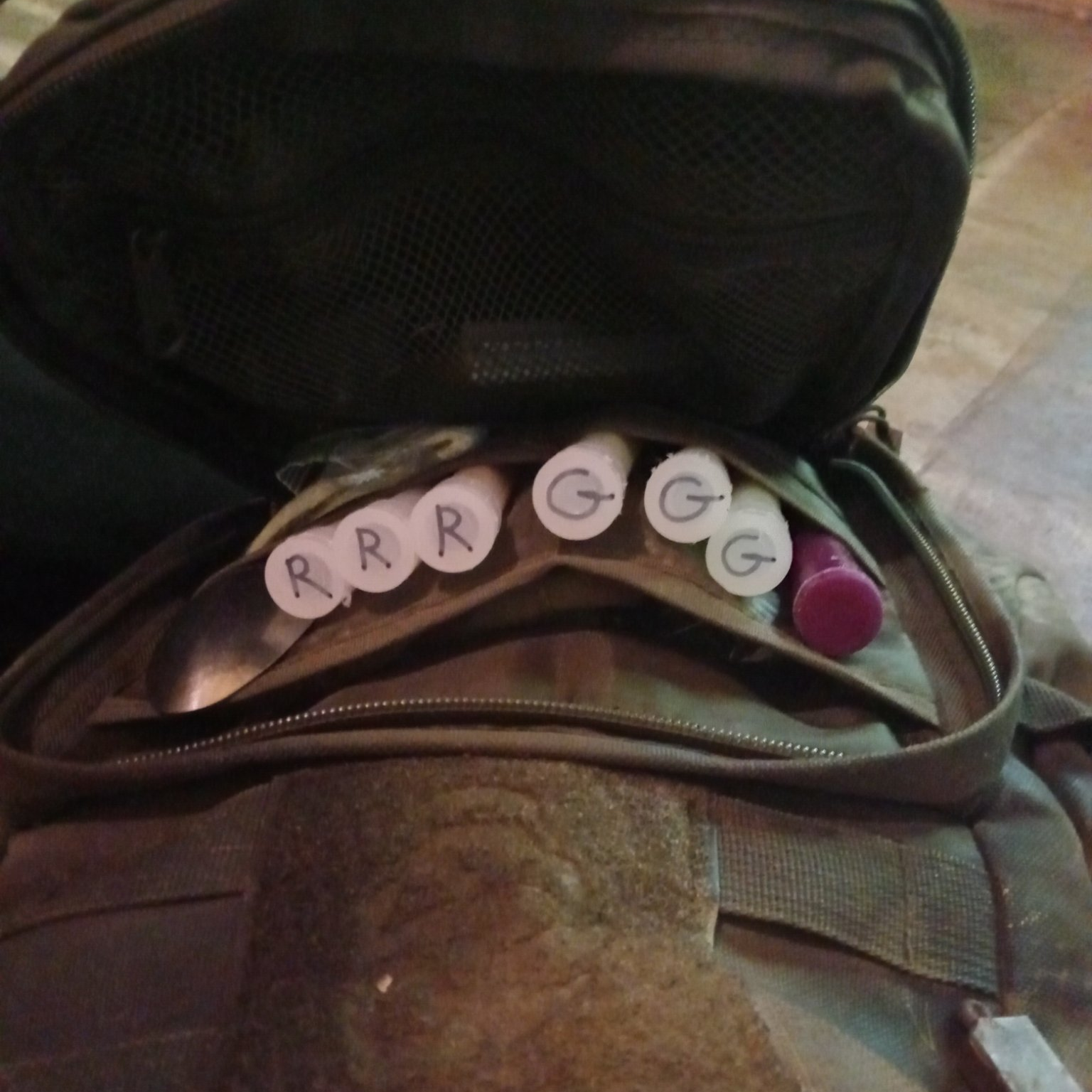
- SUSTAIN the use of an IR buzz saw to coordinate vehicle movement at night. Normal chemlights can be used instead of IR if the CASEVAC vehicle doesn’t have night vision.
- IMPROVE my own group’s casualty handling procedures. Watching these guys work on stabilizing and transporting the casualty really impressed me, and highlighted an area that my own training group could improve on.
Day 3: Mounted Operations
The final day of this course was a Sunday. I make it a point that whenever a class of mine runs into a Sunday, I begin the day with an optional Bible study to give God the firstfruits of the day. This Bible study was called “Trust in the Lord” and focused on how and why we need to focus our thoughts on God and trust in him for guidance and assistance. I began with a short look at Jonathan’s spoiling attack on the Philistines in I Samuel 14, an excellent case study on how a Godly warrior properly seeks God’s assistance.
This day’s topic was Mounted Operations, an introduction to operating mounted in vehicles. After a short class on the appropriate use cases for soft-skinned civilian vehicles, we moved outside for some drills. I demonstrated how to stow, carry, and employ weapons in a vehicle and students had a chance to practice this dry (no live fire) from both sides of a car. We also covered roles within a vehicle crew, practiced some basic communication drills, and moved to tactically mounting and dismounting a vehicle while maintaining security.
After lunch, we moved to the final portion of the class: convoy operations. I taught the class how to plan and execute a convoy, and then they actually planned and executed a 6-vehicle convoy. Since this class was taught in the students’ local area, we were able to tie-in some of their real-world reconnaissance objectives into this convoy. The drone was once again utilized, this time to scout a known choke point along the route.
The convoy itself went smoothly. I sat with the convoy commander and took notes on how they communicated, moved, and handled contingencies (like a vehicle taking a wrong turn). They acted the way they were trained, and it was pretty cool to watch the students take their instruction from that afternoon and run with it. Radio communication between vehicles was a bit rough at first, but by the end of the 40-minute convoy it had gotten much smoother and more natural. When it was all over, everyone was pretty happy with how the convoy had gone. We did a brief AAR, which was more “SUSTAIN” than “IMPROVE”.
Some key points to share are below:
- IMPROVE the route plan by using fewer checkpoints. The first part of the route was very heavy on coordination measures and the convoy commander was a bit overloaded tracking everyone’s progress. Towards the end, checkpoints were more spread out, which eased his burden and flowed much better.
- SUSTAIN using roof-mounted antennas for radios. We were getting LC radio checks between vehicles up to 3 miles away (the furthest any element of the convoy was separated at any time) with mobile 2m VHF radios. Some vehicles had to use handheld Baofeng radios inside the cab, which worked but not nearly as far. This was accounted for during planning by ensuring that the first, last, and C2 convoy vehicles had external antennas mounted.
- SUSTAIN using a drone to recon potential choke points along the route for hazards. This was much faster and safer than sending a scout vehicle ahead of the main body in restrictive terrain like canyons and bridges. A scout vehicle is still useful for normal travel along the route, but for known danger areas a drone is often a better choice unless the terrain/weather dictates otherwise.
Summary
Boltboy and I had a lot of fun running this course. The hosts were very gracious in opening their home to us and the team was a pleasure to work with. It’s always encouraging to come to a class like this and see like-minded men and women cheerfully training together towards a common goal. If you ever think that you’re the only one in your community who cares about preparedness and training, you’ve been psyopped. This group didn’t get to their current size and skill level by complaining about society on the internet, they went out into their community and met people. Your lack of a group to train with is your fault and yours alone. Don’t wait for the militia to come recruit you, because they won’t. Go outside, go to events in your community, and just talk to people. You will be surprised at the kind of folks you meet.
If you already have a few like-minded friends willing to train but don’t know how to get started, contact me. I am willing and able to travel almost anywhere in the continental US, and like these folks, I can tailor a training course that fits your timeline, your area of operations, and your training needs.
Semper discens.
 Von Steuben Training & Consulting
I highly recommend every MAG group have Mike and Boltboy come train with them. Having professional training, in your AO is THE next level of training. This year we had our wives and daughters come out to some of the classes. Mike and Boltboy provide a professional, family friendly training environment that is often lacking with some trainers.
TU
J
We have had a lot of discussion in our group about the patrol scenario. This maybe something for a TDG post. Several of us have wondered, once we found the refugees if we should have split the patrol. One group finishing the “mission” and the other questioning the refugees, seeing what intel we could gather from them and observing or “encouraging” them to move on out of our AO.
LikeLike